Singleness of Eye
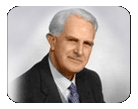
by T. Austin-Sparks
by T. Austin-Sparks
Reading: Luke 11:33-36.
I want to preface what I have to say with a brief personal word. I think what will be said may be very testing to many of us and difficult to understand or receive, but I want to say to you that this word has been deeply searching my own heart and giving me some very serious exercise before the Lord for some days past, so much so that not until now was I sure that it was a word for others, to be passed on. I say that because I want you to understand and believe that I am not preaching at you, but that this is something which must really be a matter for our mutual exercise and concern.
The Single Eye and a Luminous Body
You will see that is borne out by the context. You have a glance at that chapter. You will see there is a reference by the Master to "this evil generation (which) seeks after a sign", and He says, "there shall no sign be given to it but the sign of Jonah" (Luke 11:29). Now then, Jonah was a sign. Jonah's presence was a matter of illumination; his very presence, his bodily presence on the earth was a matter of illumination; that is, it was a matter of testimony by his personal presence. Then the reference to the queen of Sheba and the result of the queen of Sheba's visit to Solomon was that she, by her very presence, was a testimony to that glory. I think you have got to the heart of the matter.
So it is testimony, it is effectiveness, it is intrinsic value, it is our registration in the world that is referred to here in terms of light. It is not a matter of knowledge; it is a matter of being, "Thy whole body shall be luminous". It is being. It is not having, and it is not knowing here, but what we are personally. I trust that is quite clear, and if so, we are able to go on with the further meaning of the single eye. What we have said is reached and better understood by this principle that is enunciated of the single eye.
"When thine eye is single, thy whole body also is luminous". "The lamp of thy body is thine eye". The body that is the vessel of light, of testimony, demands a lamp to make it luminous. The Master here says that that lamp is the eye, and then He says that singleness of eye makes for a luminous body. We will talk more about that luminous body in a moment. Do not get wrong ideas about that. But singleness of eye makes for a luminous person being present in this world; a sign. If we start with Jonah, that is perfectly clear. Jonah's death, burial and resurrection was a sign and it became a personal matter so that he was luminous as a personal testimony to resurrection, triumph over death and death's judgment, and the cause of judgment - sin. That was the full message for Nineveh. And the queen of Sheba embodies the principle. One thing you notice about the queen of Sheba was her singleness of eye. She had heard a report. She did not say, "I do not believe it, it is exaggerated." She did not put some other construction upon it. She said, "I am going to see." Singleness of eye will lead us to personal investigation into matters, whether the report be good or evil. The contrary to singleness of eye would be prejudice, suspicion, mistrust. She went, she saw, and because singleness of eye predominated with her, she became a mighty witness in the far country to the greatness of Solomon and the greatness of Solomon's God. That by the way.
What Singleness of Eye is
It raises very many practical questions. Can we rejoice in the work of God without being the instrument, without feeling at all bad that we are not the instrument and just rejoice in the work without any place being given to us in it? Or in seeing the work of God being done and going on, do we at once get into it with self-pity or with our own ambition and desire to have some place in that, which is not a pure, utterly selfless desire, completely circumcised in heart? Can we rejoice and be thankful when the gospel is preached even of contention? You remember Paul. "Some indeed preach Christ even of envy and strife... thinking to raise up affliction for me in my bonds" (Phil. 1:15-17). Oh, their motive! Unholy motive, the evil of that heart that is not singleness of eye, that is not purity of heart. But what was Paul's reaction, "There is something wrong here; people like that ought not to be allowed to preach the gospel. The Lord ought not to use that"? Paul said, "No, whether it be even of contention, whether it is with that evil motive, I rejoice that the gospel is preached anyway!" That is singleness of eye.
Can we be even used of the Lord in any way, many ways, not only in public ministry or spoken ministry, but in other ways - in practical service, in giving - and then disappear? Go right away at once behind the curtain? It is the Lord's interest, not ours - hands off; glad to be used, but out of sight at once, not peeping round to get the appreciation or thanks for what we have done, or to have some place in things because we have helped them. All such matters go to the heart of this whole question of singleness of eye. Can we let go, and stand right back? You must not misunderstand what I am saying because there is another way of interpreting it - being careless, indifferent, "Let them get on with it!" That is only another form to the contrary of purity of heart. But I mean being out of it ourselves, letting go.
A Sole Concern for the Glory of God
The One To Whom God Will Commit Himself
But what leads to this? Is it not our deep, agonising concern before God that He will be able to commit Himself to us that we might be the more to His glory and more used by Him? Does that not concern you? Do you, with me, desire above all other things that the Lord should be able to be with us and to make us a blessing and to use us and to open the way before us, and not all the time to have to say, "I must go steady there, they are taking it into their own hands to get glory for themselves. They have become masters instead of servants"? Are you concerned about that? If you are not, of course this word has nothing for you, but if so, surely this is a word to our hearts. How will the Lord commit Himself? The Lord Jesus is the great example. He came to show, for God was with Him. That was the testimony of the apostles. He "went about doing good, and healing all that were oppressed of the devil; for God was with Him" (Acts 10:38). Oh, that is what we are after in our hearts, not the using, not the fame, not the popularity, the publicity, no, but just that God should get glory and have His way. He puts His finger upon the secret - the single eye, purity of heart.
I am not, for a moment, questioning your motives. I cannot question my own motives as I know them on the surface. You would all say, "All that I am and all I have is for the Lord; it is at the Lord's disposal. I do not want to have any secondary interest at all." We are all like that, but so often we are our own greatest enemies, and I am not speaking to you about the things of which you may be conscious. We shall, of course, have to face things which come into this realm as we know them; as we are able to discern them, we have to face them quite seriously. But I know this, that "the heart is deceitful above all things, and it is exceedingly corrupt" (Jer. 17:9). Deceitful - and we really do not always know our own motives, and the motive is only manifest sometimes when the Lord has given us a little extra rope of liberty and blessing, and then we begin to be very pleased with it and with ourselves, instead of humbly, broken-heartedly, going down before the Lord in worship that such as we, could ever be considered in the realm of His using. It is what is there. That is why I speak of circumcision of heart, getting right down inside.
Well, the opposite to singleness, of course, is dividedness, and you know how often the Lord Jesus, when He was here in the flesh, used that word "cannot", and how often He used the phrase that is here in our portion: "No man does this or that to things." "Men do not put new wine into old bottles" (Matt. 9:17) — two opposite things; "men do not put a piece of new cloth upon an old garment" (Matt. 9:16) - two different things. "Ye cannot serve God and mammon" (Matt. 6:24). "Unless you leave all, you cannot be My disciples" (Luke 14:33). These "cannots" just touch this: there can be no two things where the Lord is concerned, only one thing, singleness of eye. Pride and jealousy are only forms of self-interest. When David returned from slaying the giant, the women came out and sang, "Saul has slain his thousands, and David his ten thousands" (1 Sam. 18:7). Saul said, "They have ascribed unto David ten thousands, and to me they have ascribed but thousands. And Saul eyed David from that day and forward", eyed him with an evil eye. He was jealous, and I think it was David's singleness of eye that was the great characteristic of his life.
The Heart the Seeing Organ
Love is singleness. Love is utterly selfless. Oh, God have mercy upon us that our love is so often not that kind of love. We think it is love, but there is a good deal of selfishness about what we call love, drawing to ourselves, making even the object of love, our professed love, serve our ends. That is the tragedy of the world today, of married life. It is called love, but what is it? Serving the selfish ends of man. But true love "seeks not its own" (1 Cor. 13:5) says the apostle, but is utterly selfless, and when it is like that, we are luminous. Men can see by our presence, they can see God, see Christ, see a lot, perhaps all that they need to see, by our being here or there. We are luminaries - not by a teaching, not by what we have, but we are that. That is singleness of eye, that is purity of heart, and again I say at the end, that is the only ground on which the Lord is free to commit Himself to us. If we turn the light of the Lord's glory upon every situation, every matter, and we do not say, "This is quite permissible and harmless" for that is negative. We are positive; we say, "Is this to the glory of God?" That is the positive side, that is the single eye. The Lord grant it to us!
Edited and supplied by the Golden Candlestick Trust.


No comments:
Post a Comment