Pages

Tuesday, December 14, 2010

Delighting in God


By Warren Wiersbe

Read Psalm 18:20-27

God wants to have a personal relationship with each of us. He is the God of the individual believer through Jesus Christ, and He delights in us just as we delight in those we love. The highest and holiest experience we can have is the worshipful delight of the Lord.

This passage gives us insight into how we can delight in God and how He delights in us. First, how does one delight God? By one's character. David had integrity (v. 20). He was not free from sin, but his heart was devoted to God. Righteous means "obedient." David was obedient (vv. 21,22). He had the Word of God in his heart. God delights in us when we do what He wants us to do the way He wants us to do it (Matt. 3:17). What counts is that He delights in what we do, not what our neighbors think about us.

Second, how does God deal with those in whom He delights? He treats us the way we treat Him (vv. 25-27). We are as close to God as we want to be. David was wholly devoted to Him, so God was able to bless him. David was merciful to those who wronged him; God was merciful to him (v. 25). David was loyal; God was loyal to him (v. 25). David was pure, submissive and humble.

In contrast, Saul was devious. Shrewd means "to wrestle." God wrestles with us (as He did with Jacob) when we are perverse and devious. Parents often wrestle with their children when it comes to discipline. God wrestles with us to bring us where He wants us to be; then He can delight in us.

Third, how can we increase our delight in God and His delight in us? Believe that He wants you to be happy; happiness and holiness go together. Submit to and enjoy God's will, but not grudgingly. He will give us the best. When we delight in Him and He delights in us, life becomes delightful, and we bring glory to our Father's name.

Delighting in God is an expression of your personal relationship with Him. His delight in you is an expression of His love for you. Be the kind of person who delights God. Walk with integrity and obey His Word. He will bless you and use you to bring glory to Himself.

Emptied From Vessel to Vessel


By  John Follette


"Moab hath been at ease from his youth, and he hath settled on his lees, and hath not been emptied from vessel to vessel, neither hath he gone into captivity; therefore his taste remained in him, and his scent is not changed." (Jer. 48:11).

In the text before us we find a partial statement of the judgment against Moab. It is not my purpose to take up this judgment and from an historical standpoint show the reason for and outcome of it. But I would like to take from this verse a little group of words, really a figure of speech, and find if there be any spiritual application therein for our profit.

The words, emptied from vessel to vessel, are so suggestive! The Holy Spirit in making use of such an expression means more than we may think from a surface or careless reading. The figure has to do with wine-making. It tells one of the methods used in producing a clear, rich, well-refined wine. It is poured into a vessel and allowed to stand for a certain length of time under respective circumstances perhaps of heat, cold, light of darkness. Then it is poured again into another. Each time there is a settling of sediment and dregs which remain in the vessel as the wine-maker carefully pours the precious liquid into still another one. This process he repeats until the wine is perfectly refined and it is poured in clear smooth streams, it yields a freshness of scent or fragrance very choice and pleasing to the maker. This is not so if the wine is allowed to stand all the time in one vessel. If so, it settles upon its lees and becomes scented with the essence of the dregs and loses its proper color value.

Does not such a figure speak? We are, as Christians, familiar enough with God's methods in soul training to recognize at once its teaching. There is a very useful lesson in Scripture in which we are mentioned as vessels. The Holy Spirit uses that type to teach us lessons concerning character building, frailty, usefulness, emptiness, and other helpful truths. But the figure here is quite different; instead of being represented as vessels we are to play the part of wine which is emptied or poured out. The vessels then are quite distinct from us and are produced by the wine-maker alone and serve only for refining the wine.

I wish we could see more clearly than we do and recognize the fact that we are at the present time in the wonderful school of the Holy Ghost. God is a Master-teacher and has us, His children, in training. We are not saved, sanctified and baptized in the Holy Spirit because we are matured or a finished product. These marvelous blessings have come to us because we are not matured. So as we yield to their purposes and ends, the Holy Spirit will see to it that we are taken step by step (vessel by vessel) into growth and maturity. And with wills yielded and spirits mellowed and broken we shall then become wine on the lees well refined.

It is here we find one of the methods God uses in accomplishing the desire of His heart. What may that desire be? That we may be conformed to the image of His dear Son. This is a work indeed. When once we get a vision of what we are by nature and realize it is God's purpose to transform us into the image of Christ, we are amazed. Well we may be, for there is no natural power to carry out so titanic an undertaking. We are helpless before it and see that if ever it is done the power must come from a source other than ourselves. So it does. We are God's little children. He furnishes the means and power for our transformation. He simply asks for yielded, willing material upon which to work. Can we not afford Him this today?

Have we not all found ourselves being emptied from one vessel to another in God's ceaseless dealings? What may these vessels be? I think they represent the various trails, unique arrangement of trying circumstances, peculiar conditions, unexplainable leadings, tests in relation to healing and the general array of experiences and vicissitudes common in the life of a consecrated Christian. He does not say the vessels are all alike. That would spoil the teaching given in the figure.

The vessels are quite different; scarcely two alike in the whole number. Let us consider a few. Here is one made of glass (but it is not wine colored) and as the wine is emptied into it, it assumes a yellow tinge or a green or blue cast as the color of the vessel may produce. This is the vessel of misunderstanding. People judge the color of the wine by the color of the glass, and at once label the wine as off color. Then an endless course of reasons ensues as to the cause of its being thus colored and why such rich looking wine should suddenly take such an unusual shade. Of course the "wine" is all the time conscious of such remarks and has a prayerful time getting settled. For the wine must become absolutely still and stand long enough for the sediment to settle and cling to the bottom and sides of the vessel. Many keep the wine in motion trying to explain the fact that it is really all right; only the glass is colored. Thus there is a delay and longer time is needed to get clear wine. Just as it gets settled and there is a clear condition again, the Maker carefully lifts it up and pours it into another vessel. What is left behind? Praise God, a few more dregs of self-vindication and a few more shreds of the self-life.

As the wine is poured out, it beholds the new vessel, a large, round open receptacle--gray and ugly. ,At first there is a shrinking perhaps--for the vessel seems so unusual, so uninviting and so absolutely unlike any into which it has ever been emptied. It is so flat and open that as the wine is poured out it can no longer keep its proper course so it runs and spreads, filling the whole open vessel. This is the vessel of public gaze. It is where God pours us when we are to experience public humiliation and weakness. The wine cannot gather itself up and appear in any other shape. It must spread out flat and be open to public judgment and criticism. The trying light, the confusion, and scores of remarks made concerning the "spill," (as it seems to the people) altogether work a miracle. The wine becomes quiet, yielded and silent. Then it is poured out again. Clinging to the sides of the ugly, gray vessel there are dregs of pride and self-preservation; but added to the wine is a richer hue.

The next vessel is made of clay. It is not transparent and can reflect no light. It is tall and has a long, narrow neck. It matters not about the shape of the vessel, the wine is poured into it. As usual it has some difficulty in getting settled (owing to the darkness). It has some fear as to the certainty that it belongs there. But at last it yields and fills the vessel in quietness. Here it stands for hours, days and even months in shadow and darkness. At times the wine hears music and the delightful cries of those in light; but the clay affords no transparency so the wine remembers the light found in other days and simply trusts for light to shine again. This is the vessel of long, dark trial. The kind in which God lets us alone to prove us even in shadow and dark\-ness. But lo, it works wonders in the wine. As it is again poured forth it gleams with light--faith tried and tested. Left behind are dregs of impatience, questioning and unbelief.

That is not all. Again the wine is poured off into a new vessel. This one is unusual in size and quite unique in design. The shape is most peculiar--it is full of bulges, angles, corners, dents and ridges. The wine has a hard time in finding its way into all the odd nooks and corners. People watch it and at once consider the wine is in the wrong vessel. It was never called to go into such a receptacle. It is a waste of time, money and energy and so the wine's leadings must have been all wrong. This is the vessel of strange guidance.

What is His Name?


The God of All Comfort 2 - What is His Name?


By Hannah Whitall Smith


"And Moses said unto God, Behold, when I come unto the children of Israel, and shall say unto them, The God of your fathers hath sent me unto you; and they shall say to me, What is his name? What shall I say unto them?"

The vital question of all ages and of every human heart is here expressed, "What is his name?"

The whole fate of humanity hangs on the answer to this question.

As we know, the condition of a country depends upon the character of its rulers. The state of an army depends upon the officers who command it. And the more absolute the government, the more is this necessarily the case.

We can see how it must be, therefore, that everything in a universe will depend upon the sort of creator and ruler who has brought that universe into existence, and that the whole welfare of the human beings who have been placed there is of necessity bound up with the character of their Creator. If the God who created us is a good God, then everything must of necessity be all right for us, since a good God cannot ordain any but good things. But if He is a bad God, or a careless God, or an unkind God, then we cannot be sure that anything is right, and can have no peace or comfort anywhere.

The true ground for peace and comfort is only to be found in the sort of God we have. Therefore, we need first of all to find out what is His name, or, in other words, what is His character-in short, what sort of a God He is.

In Bible language name always means character. Names are not given arbitrarily there, as with us, but are always given with reference to the character or work of the person named. Creden in his Concordance says that the names of God signify that which He really is, and are used throughout the Bible to express His attributes, and His purposes, His glory, His grace, His mercy, and His love, His wisdom, and power, and goodness. A careful study of His names will make this plain.

When, therefore, the children of Israel asked, "What is his name?" they meant, "Who and what is this God of whom you speak? What is His character; what are His attributes; what does He do? In short, what sort of a being is He?"

The psalmist says, "They that know thy name will put their trust in thee: for thou, Lord, hast not forsaken them that seek thee." And again he says, "The name of the Lord is a strong tower, the righteous runneth into it and is safe." "They that know thy name will put their trust in thee." They cannot do anything else, because in knowing His name they know His character and His nature, that He is a God whom it is safe to trust to the uttermost. And there can be no doubt that a large part of the unrest and discomfort in so many Christian hearts comes simply from the fact that they do not yet know His name.

"Some trust in chariots and some in horses: but we will remember the name of the Lord our God. They are brought down and are fallen, but we are risen and stand upright." In all that we read concerning Israel of old we find this constant refrain, that all they were and all they had depended upon the fact that their God was the Lord. "Blessed is the nation whose God is the Lord; and the people whom he hath chosen for his own inheritance." "O Lord, there is none like thee, neither is there any God beside thee, according to all that we have heard with our ears. And what one nation in the earth is like thy people: to make thee a name of greatness and terribleness, by driving out nations from before thy people, whom thou hast redeemed out of Egypt? For thy people Israel didst thou make thine own people forever, and thou, Lord, becamest their God." "Happy is that people that is in the Lord."

Blessed is that nation, happy is that people whose God is the Lord! All the blessing and happiness of Israel arose from the fact that their God was the Lord. Nothing else was of sufficient importance to be mentioned in the recapitulation of their advantages. The fact that their God was the Lord Jehovah was enough to account for every good thing they possessed.

The question of all questions for each one of us, therefore, is this one, "What is his name?" To the Israelites God Himself answered this question. And God said unto Moses, "I am that I am"; and He said, "Thus shalt thou say unto the children of Israel, I Am hath sent me unto you." And God said, moreover, unto Moses: "Thus shalt thou say unto the children of Israel, the Lord God of your fathers, the God of Abraham, the God of Isaac, and the God of Jacob hath sent me unto you; this is my name forever, and this is my memorial unto all generations."

In the Gospel of John Christ adopts this name of "I am" as His own. When the Jews were questioning Him as to His authority, He said unto them: "Verily, verily, I say unto you, before Abraham was I am." And in the Book of Revelation He again declares: "I am Alpha and Omega, the beginning and the ending, saith the Lord, which is, and which was, and which is to come, the Almighty."

These simple words, I am, express therefore eternity and unchangeableness of existence, which is the very first element necessary in a God who is to be depended upon. No dependence could be placed by any one of us upon a changeable God. He must be the same yesterday, today, and forever, if we are to have any peace or comfort.

But is this all His name implies, simply "I am"? I am what?-we ask. What does this "I am" include?

I believe it includes everything the human heart longs for and needs. This unfinished name of God seems to me like a blank check signed by a rich friend given to us to be filled in with whatever sum we may desire. The whole Bible tells us what it means.

Every attribute of God, every revelation of His character, every proof of His undying love, every declaration of His watchful care, every assertion of His purposes of tender mercy, every manifestation of His loving kindness-all are the filling out of this unfinished "I am."

God tells us through all the pages of His Book what He is. "I am," He says, "all that my people need": "I am their strength"; "I am their wisdom"; "I am their righteousness"; "I am their peace"; "I am their salvation"; "I am their life"; "I am their all in all."

This apparently unfinished name, therefore, is the most comforting name the heart of man could devise, because it allows us to add to it, without any limitation, whatever we feel the need of, and even "exceeding abundantly" beyond all that we can ask or think.

But if our hearts are full of our own wretched "I ams" we will have no ears to hear His glorious, soul-satisfying "I am." We say, "Alas, I am such a poor weak creature," or "I am so foolish," or "I am so good-for-nothing," or "I am so helpless"; and we give these pitiful "I ams" of ours as the reason of the wretchedness and discomfort of our religious lives, and even feel that we are very much to be pitied that things are so hard for us. While all the time we entirely ignore the blank check of God's magnificent "I am," which authorizes us to draw upon Him for an abundant supply for every need.

We Need Sanctified Thinkers PART 2


A.W. Tozer

The creative religious thinker is not a daydreamer, not an ivory tower intellectual carrying on his lofty cogitations remote from the rough world. He is more likely to be a troubled, burdened man weighed down by the woes of existence, occupied not with matters academic or theoretical but the practical and personal.

The great religious thinkers of the past were rarely men of leisure; mostly they were men of affairs, close to and very much a part of the troubled world. Neither will the sanctified thinker of our times be a poet gazing at a sunset from some quiet secluded spot, but one who feels himself a traveler lost in a wilderness who must find his way to safety. That others will later follow the path he makes will not be primary in his thinking. Later he will understand this, but for the time being he will be all engaged hunting the way out for himself.

Monday, December 13, 2010

Put all sorrow's wounds into His hand

Psalm 23

(J. R. Miller, "By the Still Waters")

"He restores my soul." Psalm 23:3

In several ways does the shepherd restore his sheep.
If one wanders away, he goes out after it, and seeks
it until he finds it, restoring it to the shelter of the
fold. If one faints and grows sick by the way, in the
hard journey or the burning heat—the shepherd does
not leave it to die, but takes it up in his arms, and
carries it home, restoring it to the fold. If a sheep is
hurt, torn by a wild beast or injured by accident—the
shepherd tends its wounds until they are healed.

All this suggests how our Good Shepherd restores our
souls. Sometimes we wander away. It is very easy to
drift off from Christ. The drifting is often unconscious
—we do not realize that we are losing our first love—
and little by little, we are far off from Christ. Perhaps
it is a cherished sin which eats out our heart-life. Or
perhaps it is a worldly companionship which draws us
away, loosening the bonds which bound us to Christ.
Sometimes it is an absorbing business which leaves
no room for God. Or it may be the cares of this world
which choke the Word and quench the Spirit. We often
need to have our soul restored, quickened, revived—or
we would never get safely home, through this evil world.

Then, what soul is not sometimes hurt, wounded,
torn—by the wild beasts of temptation? Sin is a
fearful thing. It wounds the soul—and no hand but
Christ's can restore it. But if we put our hurt life
into His hand, He will give healing. What millions
of sin's woundings—has our Good Shepherd cured!
Then, when sorrow has left the heart broken, it is
only the Good Shepherd who can restore it. He is
a most skillful physician. We may put all sorrow's
wounds
 into His hand
. He is most gentle, and His
hand is infinitely skillful. He is a wonderful comforter.
No human hand can heal a heart that is bruised—but
the hand of Jesus has infinite delicacy and skill.

"He heals the brokenhearted and binds up
 their wounds. Psalm 147:3


ALMIGHTY GUIDANCE

Psalm 32:8

(John MacDuff, "THE THOUGHTS OF GOD")

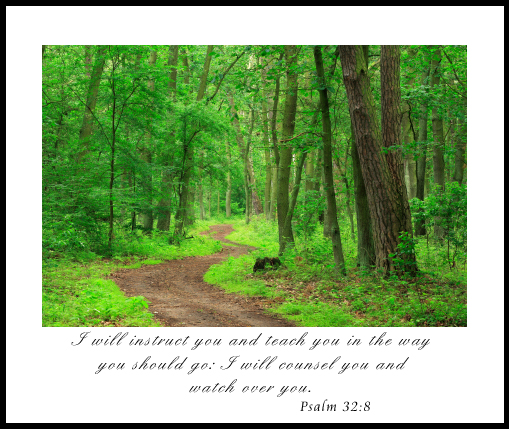
"I will instruct you and teach you in the way which you shall go; I will guide you with My eye." Psalm 32:8

No more precious assurance can I have, than this: that I am under the constant, loving guidance of my heavenly Father — that He appoints the bounds of my habitation, and overrules all events for my good — that my whole life is a plan arranged by Him! Every apparent little contingency, as well as every momentous turn and crisis-hour — forms part of that plan! "A man's heart devises his way — but the Lord directs his steps."

"I will instruct you and teach you." How patiently does this almighty Preceptor train, and with what infinite wisdom and tenderness does He adapt His varied teachings to the needs and requirements of His people! It is "line upon line;" or if need be — cross upon cross, trial upon trial. Or it may be that startling providences are no longer required — the gentle indications of His will are enough, "I will guide you with My eye." The earthquake — the hurricane — the wind — the fire, may now have fulfilled their mission. "The still, small voice" is now sufficient.

And HOW does He promise to teach and to guide? Not in the way that we would like to go — not in the way of our own choosing — but "the way which you shall go." Often we would decide on pursuing the sunny highway. But God says, 'the rough mountain-track is best for you!' Often we would, like Israel, take the near and smooth road to Canaan. But God's pillar-cloud decides otherwise, and takes us by a circuitous route "by the way of the wilderness." Often we would prefer, like the disciples at sea of Tiberias, the safe path by the seashore, so as to avoid the gathering storm, "for the wind is contrary." But God says, "No!" He constrains us to get into the boat!

"He led them by the right path — to go to a city where they could live!" It is not for us to question His plans. He led His people of old — He leads them still — by the right path. There is a day coming — when we shall own the wisdom of every earthly lesson, the "needs-be" of every wave in the troubled sea!

The gardener has occasionally to subject his plants to apparently rough treatment — cutting, lopping, mutilating; reducing them to unsightly shapes — before they burst into flower. Summer, however, before long, vindicates the wisdom of his treatment, in its clusters of varied fragrance and beauty. So also, at times, does our heavenly Gardener see fit to use His pruning-knife! But be assured that there is not one superfluous or redundant lopping. We shall understand and acknowledge an infinitely wise necessity for all — when the plant has unfolded itself into the full flower, bathed in the tints and diffusing the fragrance of Heaven.

Believer, go up and on your way — rejoicing in the teaching and guidance of unerring Wisdom! "I will guide you with My eye." Thesleepless eye of Israel's un-slumbering Shepherd is upon you by day and by night — in sickness and in health — in joy and in sorrow — in life and in death!

"The Lord watches over those who fear Him, those who rely on His unfailing love."

link


He not only makes them kings

Rev. 3:21


(William Dyer, "Christ's Famous Titles")


"To him who overcomes, I will give the right to sit with Me on My throne!" Revelation 3:21

Jesus Christ is an ENTHRONED King! But, beloved, this is not all; Christ not only sits there Himself—but He has promised that all who overcome, shall sit down with Him upon His throne!
Now, I wonder where there is any king but Christ, who allows his subjects to sit upon his throne with him. Alas! this would be treason for a man to attempt it!

Oh, what a glorious King is Jesus! Every one of His poor subjects shall sit upon the throne with Him! One would think this very promise would draw the whole world after Christ! Oh! what great offers, and privileges, and honors Christ bestows upon all His poor followers! He not only makes them kings—but He brings them to sit upon His very throne with Him!

O believer, you say that it would be an honor indeed, if could you but look into heaven, and merely to see Christ sit upon His throne! But this honor have all His saints; yes, much more—He makes them all kings, and grants to them to sit down with Him upon His throne!