Finance
By Samuel Logan Brengle
The soul-winner, to be successful, must not be over anxious about finance, but must laugh at the devil and all his fears, and count God faithful and trust Him to supply all his needs. He should again and again read over the last part of the sixth chapter of St. Matthew, beginning with verse 19. What could be stronger and more positive than the assurance of Jesus that his needs shall be supplied?
When I was a little fellow I never worried my head or heart about my next pair of shoes, or where my breakfast was to come from. My father was dead, so my mother did all that worrying, and I played and trusted her and had a good time. Well, now, Jesus says we are to take no thought (by that He means no anxious thought see Revised Version) what we shall eat or what we shall put on. "Is not the life more than meat and the body than raiment?" And if God gives you life, which is the greater, will He not give you meat to sustain life? And if He allows you still to live in your body for a season, will He not give you raiment to protect your body? "Behold the fowls of the air, for they sow not, neither do they reap, nor gather into barns, yet your Heavenly Father feedeth them. Are ye not much better than they? Therefore take no thought, saying, What shall we eat, or what shall we drink, or wherewithal shall we be clothed? for your Heavenly Father knoweth that ye have need of all these things."
Jesus would have me trust my Heavenly Father as I did my mother. Then I call be a child again, bless the Lord! and all I have to do is to pray and obey and trust the Lord, and have a good time before the Lord, and He will supply my needs and the needs of my little ones whom He has given me. Yes, that is what He means, for He says, "Seek first the Kingdom of God and His righteousness and all these things shall be added unto you." And this freedom from worrying anxiety is the privilege and duty of all soul-winners, from the carefree worker who has only to get bread for his own mouth to him who has a large family to feed and clothe, or the man with a thousand-fold financial responsibility like Moses, or George Mueller, or Hudson Taylor, or our God-honored and beloved General. Faith -- simple faith, unmixed faith in God's promise -- can no more exist in the same heart with worry than can fire and water, or light and darkness, consort together; one extinguishes the other. Faith in the plain, unmistakable promise of God, begotten by the Holy Ghost, so links the soul-winner to Jesus, so yokes them up and unites them in partnership together, that the burden and care is the Lord's, since "the cattle on a thousand hills and the silver and the gold are His;" and He would have His child trust Him, walk the waves with Him, never doubt Him, shout the victory through Him and triumph over all fear and all the power of the enemy in Him. I do declare that according to the Word of God this is His will for the soul-winner, and this secret every true soul-winner must and does know. Hallelujah!
God does not send the soul-winner to a warfare at his own charges, but according to Paul, "will supply all your need according to His riches in glory by Christ Jesus."
God's commissary department is abundantly full and runs on schedule time, but the worried and anxious unbeliever wants Him to run ahead of schedule time. No, no! He may in order to test and strengthen faith, not provide the second suit until the first one is ready to be laid aside, and sometimes after supper he may allow you to go to bed not knowing where the breakfast is to come from, but it will come at breakfast time. "He knoweth that ye have need of these things," so trust Him, as does the sparrow. The wee thing tucks its tiny head under its little wing and sleeps, not knowing where it will find its breakfast, and when the day dawns it chirps its merry note of praise, and God opens His great hand and feeds it. "The eyes of all wait upon Thee and Thou givest them their meat in due season. Thou openest Thine hand and satisfiest the desire of every living thing." said the Psalmist (Ps. 145:15, 16), and "Ye are of more value than many sparrows," said Jesus.
Sunday, February 20, 2011


Saturday, February 19, 2011
Dear Miss Medhurst
(Letters of John Newton)
"Looking unto Jesus, the author and finisher of our faith!" Hebrews 12:2
Dear Miss Medhurst,
The best advice I can send, or the best wish for you, is, that you may have an abiding and experimental sense of those words of the apostle which are just now upon my mind, "Looking unto Jesus!" The duty, the privilege, the safety, the unspeakable happiness, of a believer — are all comprised in that one sentence! Let us first pray that the eyes of our faith and understanding may be opened and strengthened; and then let us fix our whole gaze upon Him!
But HOW are we to behold Him? I answer, in the looking-glass of His written Word! There He is represented to us in a variety of views. The wicked world can see no form nor loveliness in the portraiture He has given of Himself. Yet blessed be God, there are those who can "behold His glory as the glory of the only begotten Son of God, full of grace and truth!" And while they behold it — they find themselves "changed into His image, from glory to glory," by the transforming influence of the Spirit.
In vain do we use our reasonings and arguments, and resolutions — to beat down our sins and corruptions, and to silence our fears; but a believing view of Jesus does the business!
When heavy trials in life are appointed to us, and we are called to give up, or perhaps to pluck out, a right eye — it is an easy matter for a bystander to say "Be comforted;" and it is as useless as easy; but a view of Jesus by faith comes home to the point.
When we can fix our thoughts upon Him, as laying aside all His honors, and submitting for our sakes to drink off the bitter cup of the wrath of God to the very dregs; and when we further consider: that He who thus suffered for our sins, knows and sympathizes with all our weaknesses; that He is now the Supreme Disposer of all that concerns us; that He numbers the very hairs of our heads, appoints every trial we meet with in number, weight, and measure; and will allow nothing to befall us but what shall contribute to our good — this view, I say, is a medicine suited to the disease, and powerfully reconciles us to every cross!
When Jesus is upon our thoughts, either in His humbled — or His exalted state; either as bleeding on the cross — or as worshiped by all the host of heaven — then we can ask the apostle's question with a befitting disdain, "Shall we continue in sin that grace may abound? God forbid!" What! shall I sin against my Lord, my Love, my Friend — who once died for my sins, and now lives and reigns on my behalf! What! shall I sin against my Redeemer who supports, and leads, and guides, and feeds me every day? God forbid! No! I would rather wish for a thousand hands and eyes, and feet, andtongues — for ten thousand lives — that I might devote them all to His blessed service!
"Looking unto Jesus, the author and finisher of our faith!" Hebrews 12:2
link
"Looking unto Jesus, the author and finisher of our faith!" Hebrews 12:2
Dear Miss Medhurst,
The best advice I can send, or the best wish for you, is, that you may have an abiding and experimental sense of those words of the apostle which are just now upon my mind, "Looking unto Jesus!" The duty, the privilege, the safety, the unspeakable happiness, of a believer — are all comprised in that one sentence! Let us first pray that the eyes of our faith and understanding may be opened and strengthened; and then let us fix our whole gaze upon Him!
But HOW are we to behold Him? I answer, in the looking-glass of His written Word! There He is represented to us in a variety of views. The wicked world can see no form nor loveliness in the portraiture He has given of Himself. Yet blessed be God, there are those who can "behold His glory as the glory of the only begotten Son of God, full of grace and truth!" And while they behold it — they find themselves "changed into His image, from glory to glory," by the transforming influence of the Spirit.
In vain do we use our reasonings and arguments, and resolutions — to beat down our sins and corruptions, and to silence our fears; but a believing view of Jesus does the business!
When heavy trials in life are appointed to us, and we are called to give up, or perhaps to pluck out, a right eye — it is an easy matter for a bystander to say "Be comforted;" and it is as useless as easy; but a view of Jesus by faith comes home to the point.
When we can fix our thoughts upon Him, as laying aside all His honors, and submitting for our sakes to drink off the bitter cup of the wrath of God to the very dregs; and when we further consider: that He who thus suffered for our sins, knows and sympathizes with all our weaknesses; that He is now the Supreme Disposer of all that concerns us; that He numbers the very hairs of our heads, appoints every trial we meet with in number, weight, and measure; and will allow nothing to befall us but what shall contribute to our good — this view, I say, is a medicine suited to the disease, and powerfully reconciles us to every cross!
When Jesus is upon our thoughts, either in His humbled — or His exalted state; either as bleeding on the cross — or as worshiped by all the host of heaven — then we can ask the apostle's question with a befitting disdain, "Shall we continue in sin that grace may abound? God forbid!" What! shall I sin against my Lord, my Love, my Friend — who once died for my sins, and now lives and reigns on my behalf! What! shall I sin against my Redeemer who supports, and leads, and guides, and feeds me every day? God forbid! No! I would rather wish for a thousand hands and eyes, and feet, andtongues — for ten thousand lives — that I might devote them all to His blessed service!
"Looking unto Jesus, the author and finisher of our faith!" Hebrews 12:2
link
The process was not easy!
(J. R. Miller, "The Friendships of Jesus" 1897)
"Jesus looked at him and said—You are Simon, son of John.
You will be called Cephas (which means 'Rock')." John 1:42
"You are Simon." That was his name then.
"You will be called Cephas." That was what he would become.
This did not mean that Simon's character was changed instantly into the quality which the new name indicated. It meant that this would behis character by and by—when the work of grace in him was finished. The new name was a prophecy of what he was to become—the man that Jesus would make of him. Now he was only Simon—rash, impulsive, self-confident, vain—and therefore weak and unstable.
The process was not easy!
Simon had many hard lessons to learn!
Self-confidence had to be changed into humility.
Impetuosity had to be disciplined into quiet self-control.
Presumption had to be awed and softened into reverence.
Heedlessness had to grow into thoughtfulness.
Rashness had to be subdued into prudence.
Weakness had to be tempered into calm strength.
Thus lesson after lesson did Simon have to learn, each one leading to a deeper humility.
It took a great deal of severe discipline to make him into the strong, firm man of rock, that Jesus set out to produce in him. The price which he had to pay to attain this nobleness of character and this vastness of holy influence—was not too great.
But how about ourselves? It may be quite as hard for some of us to be made into the image of beauty and strength, which the Master has set for us. It may require that we shall pass through experiences of loss, trial, temptation and sorrow.
Life's great lessons are very long, and cannot be learned in a day; nor can they be learned easily. But at whatever cost, they are worth while. It is worth while for the gold to pass through the fire—to be made pure and clean. It is worth while for the gem to endure the hard processes necessary to prepare it for shining in its dazzling splendor. It is worth while for a Christian to submit to whatever severe discipline may be required—to bring out in him the likeness of the Master, and to fit him for noble living and serving.
link
"Jesus looked at him and said—You are Simon, son of John.
You will be called Cephas (which means 'Rock')." John 1:42
"You are Simon." That was his name then.
"You will be called Cephas." That was what he would become.
This did not mean that Simon's character was changed instantly into the quality which the new name indicated. It meant that this would behis character by and by—when the work of grace in him was finished. The new name was a prophecy of what he was to become—the man that Jesus would make of him. Now he was only Simon—rash, impulsive, self-confident, vain—and therefore weak and unstable.
The process was not easy!
Simon had many hard lessons to learn!
Self-confidence had to be changed into humility.
Impetuosity had to be disciplined into quiet self-control.
Presumption had to be awed and softened into reverence.
Heedlessness had to grow into thoughtfulness.
Rashness had to be subdued into prudence.
Weakness had to be tempered into calm strength.
Thus lesson after lesson did Simon have to learn, each one leading to a deeper humility.
It took a great deal of severe discipline to make him into the strong, firm man of rock, that Jesus set out to produce in him. The price which he had to pay to attain this nobleness of character and this vastness of holy influence—was not too great.
But how about ourselves? It may be quite as hard for some of us to be made into the image of beauty and strength, which the Master has set for us. It may require that we shall pass through experiences of loss, trial, temptation and sorrow.
Life's great lessons are very long, and cannot be learned in a day; nor can they be learned easily. But at whatever cost, they are worth while. It is worth while for the gold to pass through the fire—to be made pure and clean. It is worth while for the gem to endure the hard processes necessary to prepare it for shining in its dazzling splendor. It is worth while for a Christian to submit to whatever severe discipline may be required—to bring out in him the likeness of the Master, and to fit him for noble living and serving.
link
When they are twisted out of my hand
("Solitude Sweetened" by James Meikle, 1730-1799)
"Mankind is born for trouble as surely as sparks fly
upward." (Job 5:7)
O, what losses and crosses, sorrows and distresses,
uncertainties and anxieties, do mankind labor under!
Godly wisdom will lead me to expect nothing but vanity
and vexation here below. But, O! how happy is the soul
that has all the treasure in heaven--all his happiness in
God! May this be my case, and then I shall triumph in the
midst of losses, distresses, disappointments, and pain!
I take a loose hold of all earthly things, that when
they are twisted out of my hand--they may not
torment my heart!
Eternal felicity secured, is a noble panacea, and
a sufficient antidote against the heaviest misfortunes
and disappointments of this deceitful world!
I rest, and am composed, and calmly wait on You,
resigned to heaven's determination, in everything
concerning me in time--until I arrive at that better
country, at that perfect state, where there is
neither disappointment nor pain!
link
"Mankind is born for trouble as surely as sparks fly
upward." (Job 5:7)
O, what losses and crosses, sorrows and distresses,
uncertainties and anxieties, do mankind labor under!
Godly wisdom will lead me to expect nothing but vanity
and vexation here below. But, O! how happy is the soul
that has all the treasure in heaven--all his happiness in
God! May this be my case, and then I shall triumph in the
midst of losses, distresses, disappointments, and pain!
I take a loose hold of all earthly things, that when
they are twisted out of my hand--they may not
torment my heart!
Eternal felicity secured, is a noble panacea, and
a sufficient antidote against the heaviest misfortunes
and disappointments of this deceitful world!
I rest, and am composed, and calmly wait on You,
resigned to heaven's determination, in everything
concerning me in time--until I arrive at that better
country, at that perfect state, where there is
neither disappointment nor pain!
link
WATCHMEN UPON THE WALLS

WATCHMEN UPON THE WALLS
by JAMES BOURNE
"I have set watchmen upon thy walls, O Jerusalem, which shall never hold their peace day nor night: ye that make mention of the LORD, keep not silence." (Isaiah 62:6)
The prophet begins this chapter with much zeal to show the Lord's peculiar care over his afflicted people. "For Zion's sake will I not hold my peace, and for Jerusalem's sake I will not rest, until the righteousness thereof go forth as brightness, and the salvation thereof as a lamp that burneth" (verse 1) and he even declares that we Gentiles shall be partakers of the righteousness of Christ, and shall really see and understand the glory of the Lord's rich grace and mercy. Old things shall pass away, the old formal worship denying the power.
You shall be called by a new name, no more a servant, but a son, and this the Lord, the Holy Spirit will witness in our hearts and write it there. It shall prove an everlasting name that neither men nor devils shall cut off, because the mouth of the Lord hath spoken it. (verse 2)
This glorious work of God is so delightful to himself. For he says he delights in all who hope in his mercy, that they are said to be a crown of glory, and a royal diadem of beauty in the hand of the Lord. Surely what safety all this denotes, and yet in trouble how hard we find it to believe.
It is further added, "Thou shall no more be termed Forsaken," (verse 4) that is, the Lord will never more leave thee, never, never forsake thee, because his delight is in thee. "For as a young man marrieth a virgin, so shall thy sons marry thee: and as the bridegroom rejoiceth over the bride, so shall thy God rejoice over thee." (verse 5) This is the reason why he sets watchmen to guard this his rich treasure night and day. All this is for the sake of his church and people who are often found in a very low place, although the security of all nations depends upon the few scattered sheep of Christ.
The Lord shows us in this text the means he chooses for the perfection of his people, is a faithful ministry. "I have set watchmen upon thy walls." Their business is to be like their Master, neither to slumber, nor sleep. We conceive that what is meant by never holding their peace, is unceasingly to seek the welfare of the people, in private prayer, and every way promoting the welfare of God's people, as faithful servants of Jesus Christ. "Ye that make mention of the LORD," of his having done any thing for you, "keep not silence," but declare it in simplicity to the afflicted, that they may be encouraged to hope for the same.
Put on the whole armour of God, and make it manifest you are a good soldier of Jesus Christ, [that ye may] be able to stand against the wiles of the devil, (Eph. 6:10-20) who watches every opportunity to destroy all profiting, by pride, prejudice, contention, or in whatever way he can enter. His is sure to give a faithful ministry no rest, therefore it follows immediately after the text, that God's people must never give the Lord rest, but by unceasing prayers call upon the Lord to establish them that they may be a praise in the earth; and not a disgrace in turning aside to folly on all occasions. "And give him no rest, till he establish, and till he make Jerusalem a praise in the earth." (verse 7)
It is a sad sign of an hypocritical professor, when instead of growing in knowledge and understanding there is a turning aside to some foolishness that brings on darkness, and a sad reproach upon the righteous cause of God. These have no regard to the house of God, nor any feeling sense of the Lord's coming or going. To these his absence is just as good as anything else. There is no feeling sense of God's wrath against their sin, nor any fear of the destruction that awaits them for it. Some of these show a wish to retain their outward profession of religion, but are not aware that when the foundation is so removed, the outward building must of necessity fall sooner or later.
A faithful watchman will sound the alarm. offence is often taken at it, like a poor man who had turned aside, and being reproved for it, he said he would have no more of this. He was watched for many years and often tried to return, but the Lord took him at his word. He could find no place of repentance, and at length died. Indeed he never had any more hope or help from the Lord. And in that state he finished his course.
The Hope of His Calling

By A.W. Pink
What is meant by "the hope of His calling"? This is really a double question: What is meant by the word hope in this passage, and what is meant by His calling?
In Scripture hope always respects something future, and signifies far more than a mere wish that it may be realized. It sets forth a confident expectation that it will be realized (Ps. 16:9). In many passages hope has reference to its object, that is, to the thing expected (Rom 8:25), the One looked to: "O Lord, the hope of Israel" (Jer. 17:13). In other passages refers to the grace of hope, that is, the faculty by which we expect. Hope is used in this sense in 1 Corinthians 13:13: "Now abideth faith, hope, charity." Sometimes hope expresses the assurance we have of our personal interest in the thing hoped for: "tribulation worketh patience; and patience, experience; and experience, hope; and hope maketh not ashamed" (Rom. 5:3, 5). That is, hope deepens our assurance of our personal confidence in God. In still other cases hope has reference to the ground of our expectation. The clause "there is hope in Israel concerning this thing" (Ezra 10:2) means there were good grounds to hope for it. "Who against hope believed in hope" (Rom. 4:18): though contrary to nature, Abraham was persuaded he had sufficient ground to expect God to make good His promise. The unregenerate are without hope (Eph. 2:12). They have hope, but it is based on no solid foundation.
Now in the last mentioned sense we regard the word hope as being used in our present passage: that you may know the ground on which rests your expectation of His calling, that you may be assured of your personal interest therein, that you may stand in no doubt regarding the same, that you may be so enlightened from above as to be able to clearly perceive that you have both part and lot in it. In other words, that your evidence of this ground of faith may be clear and unmistakable. First, Paul prayed for an increased knowledge of God, that is, such spiritual sights and apprehensions of Him as led to more real and intimate fellowship with Him, which is the basic longing of every renewed soul. And what did he desire next to that? Was it not that which contributed most to his peace and comfort, namely, to be assured of his own filial relation to God? What does it avail my soul to perceive the excellency of the divine character unless I have scriptural warrant to view Him as God? That is what I need to have continually kept fresh in my heart.
What is Meant by "His calling"?
Here is another term which is used by no means uniformly in the Scriptures. Broadly speaking, there is a twofold calling of God or call from God: an external one and an internal one. The former is made to all who hear the gospel: "Unto you, O men, I call; and My voice is to the sons of man" (Prov. 8:4). "Many are called, but few chosen" (Matthew 20:16). That external call through the Scriptures is addressed to human responsibility and meets with universal rejection. "I have called, and ye refused; I have stretched out My hand, and no man regarded" (Prov. 1:24). "Come, for all things are now ready; and they all with one consent began to make excuse" (Luke 14:18).
But God gives another call to His elect; a quickening call, an inward call, an invincible call, what the theologians term His effectual call. "Whom He did predestinate, them He also called: and whom He called, them He also justified" (Rom. 8:30). This is calling from death to life. Out of darkness into God's "marvelous light" (1 Pet. 2:9). As the closing verses of 1 Corinthians1 tell us, not many receive this call; it is one of mercy and discriminating grace.
Our Text Then Speaks of the effectual call, and it is called His calling, because God is the Author of it. The regenerate are "the called according to His (eternal) purpose" (Rom. 8:28), because God is the Caller. Yet, having said that much, we have only generalized, and we must bring out the various shades of meaning which the same word bears in different verses. In some passages the effectual call which God gives His people refers to that work of grace itself, as in 1 Peter 2:9. In others it concerns more especially that to which God has called them-"unto His kingdom and glory" (1 Thess. 2:12), "unto holiness" (1 Thess. 4:7). There seems to be nothing in our present verse which requires us to restrict the scope of the word, so we shall interpret it in its double sense; "that ye may be assured ye have been made partakers of God's effectual or regenerative call: that ye may perceive the sure grounds of hope which God has called you unto."
Life Of Paul
By W.B. Dunkum
The Sacred scriptures give us an accurate account of the life, death, resurrection and ascension of Jesus Christ; also, a beautiful description of the descent of the Holy Ghost at Pentecost upon the apostles before Saul of Tarsus is mentioned. He is first introduced to us as a persecutor of those who followed the Christ; also, we see him assisting the murderers of Stephen in their bloody deed. Saul relates the fact that he consented to the death of Stephen and kept the raiment of those that slew him. No doubt you are anxious to know in the beginning of this discussion as to who was Saul. He is of age. Let him speak for himself. "I am verily a man which am a Jew, born in Tarsus, a city in Cicilia."
At that time Tarsus was a very famous city, noted for its magnificence and beauty, the center of culture and scholarship. It was here Saul spent his boyhood days. Most probably he had several brothers and sisters. His father was a Jew, a descendent of Abraham, of the tribe of Benjamin. No doubt he gave his son religious training after the strictest sect of his religion. The young Jew was likewise taught a trade, that of tent-making.
There is a Jewish maxim, "He who teaches not his son a trade, teaches him to be a thief." But Saul was destined for a nobler calling than that of tent making. No doubt the learned people of Tarsus hoped some day to see Saul holding a high position in their midst, as they boasted of having one of the greatest universities of the world, and it is natural for us to suppose that Saul at an early age enrolled as a student in this great university. However, he did not complete his education there, but was sent to the holy city of Jerusalem to be taught according to the law of his father.
Saul's chief instructor at Jerusalem was Gamaliel, a learned Doctor of the law, a man of eminence and ability, whose reputation was great among all people. Prof. Gamaliel is believed to have been the son of Simeon who took Jesus in his arms in the temple and blessed him. Saul makes great progress as a student. Gamaliel was a Pharisee of the strictest kind. No wonder Saul became narrow-minded and could not tolerate any religious sect that differed from his own.
We have no record as to how Saul spent the years that intervened between the time he left Gamaliel's school at Jerusalem until he appeared as a persecutor of those who followed Jesus Christ; but probably he spent it with his parents at Tarsus, where he no doubt pursued the studies of Hebrew, Greek, Latin, Law, Arts, Science and Philosophy. At this time the word of God is increasing and number of disciples multiplying at Jerusalem, and there is a company of followers who are obedient to the faith.
The enemies of Jesus are being alarmed, and some are resorting to persecution. Saul seems to hate the Nazarenes, and no doubt has only heard of this doctrine in a perverted form. As soon as Saul thought his religion was in danger he left home-- studies and all, but his zeal caused him to do many things contrary to the teaching of Jesus. He abhorred and scorned at the idea that the son of a poor carpenter who had made intimate friends of some fishermen should become the Messiah.
The first martyr was Stephen, one of the seven deacons who was officially appointed totake charge of all money for the relief of the poor as well as preach the gospel and lead souls to Christ. He being a man full of faith and of the Holy Ghost did wonders among the people. Stephen preached to different nationalities in the synagogue. No doubt Saul heard him preach, and Saul being a learned pupil of Gamaliel, could not resist the wisdom and spirit by which Stephen spake. At this time Stephen was taken before the Sanhedrin and false witnesses were called for who testified that he had been blaspheming against God. But at this time Stephen was very calm and steady until those looking at him said his face shone as if it had been the face of an angel. Read Acts 7:55-60.
As to the place of Stephen's burial, we fail to find a sufficient account; some have thought Joseph provided a tomb for the mangled remains of the first martyr of the Christian church. Saul was caused to marvel over the courage, love and forgiveness of the followers whom he regarded as an impostor. No doubt the time came when Saul mourned bitterly because he took apart in the stoning of Stephen.
I like to think that the angelic face of this dying martyr was one of the steps which brought about the conversion of Saul. The smiling face of the dying man haunted him, yet he proceeds to make havoc of the church, entering into every home, and haling men and women, putting them in prison. Perhaps many who were assembled in the upper room after the ascension were put in prison, and many homes in Jerusalem were vacated because they were afraid of the man who thought he was doing God's service. Christianity has had to suffer intensely through past ages because of various persecutors.But one might ask the question, why Christianity has had to plow her way through scenes of suffering?
Unadorned Life

"These were the potters, and those that dwelt among plants and hedges: there they dwelt with the king for his work" (1 Chron. 4:23).
Anywhere and everywhere we may dwell "with the king for his work." We may be in a very unlikely and unfavorable place for this; it may be in a literal country life, with little enough to be seen of the "goings" of the King around us; it may be among the hedges of all sorts, hindrances in all directions; it may be furthermore, with our hands full of all manner of pottery for our daily task.
No matter! The King who placed us "there" will come and dwell there with us; the hedges are right, or He would soon do away with them. And it does not follow that what seems to hinder our way may not be for its very protection; and as for the pottery, why, that is just exactly what He has seen fit to put into our hands, and therefore it is, for the present, "His work."
--Frances Ridley Havergal
"Go back to thy garden-plot, sweetheart!
Go back till the evening falls,
And bind thy lilies and train thy vines,
Till for thee the Master calls.
Go back till the evening falls,
And bind thy lilies and train thy vines,
Till for thee the Master calls.
"Go make thy garden fair as thou canst,
Thou workest never alone;
Perhaps he whose plot is next to thine
Will see it and mend his own."
Thou workest never alone;
Perhaps he whose plot is next to thine
Will see it and mend his own."
The colored sunsets and starry heavens, the beautiful mountains and the shining seas, the fragrant woods and painted flowers, are not half so beautiful as a soul that is serving Jesus out of love, in the wear and tear of common, unpoetic life. --Faber
The most saintly spirits are often existing in those who have never distinguished themselves as authors, or left any memorial of themselves to be the theme of the world's talk; but who have led an interior angelic life, having borne their sweet blossoms unseen like the young lily in a sequestered vale on the bank of a limpid stream. --Kenelm Digby
Pure Words

Read Psalm 12:1-8
When you feel deserted, alone in standing for what's right, read Psalm 12.
The emphasis in this psalm is on words, on speaking. First, David speaks in prayer (vv. 1-3). Where are the godly? People today don't want to take a stand for the truth, but David stood for what is right.
Sometimes we feel the faithful have disappeared--those who believe in prayer, giving and commitment. Today's generation doesn't believe in commitment, especially with our words. We hear so much empty talk, lies and flattery. Flattery is manipulative, not communicative, like our advertising and some of our preaching.
Second, the wicked speak in pride (v. 4). Never underestimate the power of speech. Jesus told the truth; His enemies argued. He gave words of life; they rejected Him. He came in love; they crucified Him. One of the evidences that a person is giving the truth of God's Word is that he is rejected. People don't want to hear truth unless they belong to truth (John 10:4).
Third, God speaks in promise (vv. 5,7). His words are pure, not empty lying (v. 6). But the words of the wicked will burn in the furnace. God's Word is precious, because it cost Jesus' life.
It is proved (v. 6) and permanent (v. 7). He keeps His promises. God knows where His people are, and He helps them. "I will arise"; "I will protect"; "I can be trusted" (vv. 5-7).
So much that is spoken in this world is untrue and empty talk. Be encouraged that God speaks in promise. His Word is pure and true. When you are surrounded by lies, rest on the promises of the Bible.
Friday, February 18, 2011
Significant Salutations
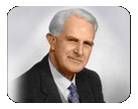
By T. Austin-Sparks
Reading: Romans 16
This is a chapter which I expect you do not often read. The letter proper seems to end with the "Amen" of 15:33, and it is easy to regard the final chapter as of little importance. But even though it may be a struggle to read it, I suggest that the effort is well worth making. Like some of the Old Testament chapters devoted to names and genealogies, this should not be skipped as irrelevant, for these are included by divine inspiration and with a purpose.
Two preliminary observations may be of interest. The first is that the list of names here is so comprehensive that it might almost be called universal. Roman names are in the minority, being outnumbered by the Jewish and Greek ones, yet taken together they represent the world of their time. This was not a Latin church, a Jewish church nor a Greek church, but a true representation of that Church which is composed of men from every nation.
The other point is that this is one of the two churches which Paul had never visited, the other being Colosse. Paul had yet to go to Rome, which he later did, but that was some time later. Even at this juncture, however, there were quite a few people whom he already knew personally and even intimately. This is more than a mere item of interest. It seems to indicate something of how in those days the gospel spread abroad and the churches were built. For one reason or another, for business purposes or by political compulsion, people had to move about in the world. This may have been inconvenient and at times most unjust, but behind that movement was the sovereignty of God, using everything for the speeding up of the work of the gospel.
This gives us encouragement, then, to know that once our lives are wholly given over to the Lord, His sovereignty will govern and overrule all the ordinary affairs and circumstances of daily life and make them contribute to His purposes and glory. Take the cruel decree of the Emperor Claudius which expelled all Jews from Rome. Whether he was following some political scheme or simply venting his spite, the fact remains that people like Aquila and Priscilla had to abandon their home and business and become displaced persons in Corinth. This, however, not only brought them into contact with Paul but later, at Ephesus, made them such a great help to Apollos and gave them an honoured place in this list which we are considering.
Their case opens up to us a world within a world, and it is a world of spiritual romance. If we could pass from one of the names of this chapter to another, we would doubtless find that in each case there were marvellous evidences of God's sovereign working, even at times before those concerned were actually converted to Christ.
Some have even thought that the fact of there being saints in the Praetorian guard (Philippians 4:22) suggests that the centurion who stood by the cross at Calvary went back from his foreign service in Palestine to his headquarters in Rome and there witnessed to the Saviour. This may be only imagination, but it is at least possible, and just the kind of way in which Christ is always building His Church.
What is more, when we look more deeply into this chapter we find that the people here referred to not only had their lives overruled by God but were themselves intent on the Lord's business and ready to take responsibility for His interests. They were not passengers, just people who happened to come and go, individuals in the crowd; they each got involved to the utmost in the affairs of the kingdom of Christ.
Paul's comments and allusions make it clear that the gospel was furthered and the churches established because these men and women put the Lord's interests before everything else in their work, their journeys and their circumstances. They had the urge of the divine imperative. Like their Lord before them, their lives were not at the mercy of chance but characterised by the word 'must'.
Let every man abide in the same calling

By A.B. Simpson
Do you complain about your calling or fret about the changes and trials of life? How do you know but that these very changes are the divine methods by which God's purposes of blessing and usefulness concerning you are being fulfilled?
Had Aquila and Priscilla not been compelled to leave Rome and break up their home and business, they probably would never have met Paul, nor would they have come to know and serve Christ through this providential meeting.
Had they not been working persons pursuing their ordinary vocation, they would not have been brought into contact with the apostle. it was in the line of their calling, their common duties and the providential changes of their lives that God called them.
And so He meets us. Do not attempt to run away from your calling, but, as the apostle has so aptly put it, Let every man wherein he is called, therein abide with God (1 Corinthians 7:24). Make the most of your incidental opportunities.
GOD'S WARNINGS

Sermons on National Subjects, 31 - GOD'S WARNINGS
By Charles Kingsley
It may be that the house of Judah will hear all the evil which I purpose to do unto them; that they may return every man from his evil way; that I may forgive their iniquity and their sin.--JEREMIAH xxxvi. 3.
The first lesson for this evening's service tells us of the wickedness of Jehoiakim, king of Judah. How, when Jeremiah's prophecies against the sins of Jehoiakim and his people were read before him, he cut the roll with a penknife, and threw it into the fire. Now, we must not look on this story as one which, because it happened among the Jews many hundred years ago, has nothing to do with us; for, as I continually remind you, the history of the Jews, and the whole Old Testament, is the history of God's dealings with man--the account of God's plan of governing this world.
Now, God cannot change; but is the same yesterday, to-day, and for ever; and therefore His plan of government cannot change: but if men do as those did of whom we read in the Old Testament, God will surely deal with them as He dealt with the men of the Old Testament. This St. Paul tells us most plainly in the tenth chapter of 1 Corinthians, where he says that the whole history of the Jews was written for our example--that is for the example of those Christian Corinthians, who were not Jews at all, but Gentiles as we are; and therefore for our example also.
He tells them, that it was Christ Himself, the Lord Jesus Christ, who fed and guided the old Jews in the wilderness, and that the Lord will deal with us exactly as He dealt with the old Jews.
Therefore it is a great and fearful mistake, to suppose that because the Jews were a peculiar people and God's chosen nation, that therefore the Lord's way of governing them is in any wise different from His way of governing us English at this very day; for that fancy is contrary to the express words of Holy Scripture, in a hundred different places; it is contrary to the whole spirit of our Prayer Book, which is written all through on the belief that the Lord deals with us just as He did with the Jewish nation, and which will not even make sense if it be understood in any other way; and besides, it is most dangerous to the souls and consciences of men.
It is most dangerous for us to fancy that God can change; for if God can change, right and wrong can change; for right is the will of God, and wrong is what is against His will; and if we once let into our hearts the notion that God can change His laws of right, our consciences will become daily dimmer and more confused about right and wrong, till we fall, as too many do, under the prophet's curse, "Woe to them who call good evil, and evil good; who put sweet for bitter, and bitter for sweet," and fancy, like Ezekiel's Jews, that God's ways are unequal; that is, unlike each other, changeable, arbitrary, and capricious, doing one thing at one time, and another at another. No. It is sinful man who is changeable; it is sinful man who is arbitrary. But The Lord is not a man, that He should lie or repent; for He is the only-begotten Son, and therefore the express likeness, of The Everlasting Father, in whom is no variableness, nor shadow of turning.
But some may say, Is not that a gloomy and terrible notion of God, that He cannot change His purpose? Is not that as much as to say that there is a dark necessity hanging over each of us; that a man must just be what God chooses, and do just what He has ordained to do, and go to everlasting happiness or misery exactly as God has foreordained from all eternity, so that there is no use trying to do right, or not to do wrong? If I am to be saved, say such people, I shall be saved whether I try or not; and if I am to be damned, I shall be damned whether I try or not. I am in God's hands like clay in the hands of the potter; and what I am like is therefore God's business, and not mine.
No, my friends, the very texts in the Bible which tell us that God cannot change or repent, tell us what it is that He cannot change in-- in showing loving-kindness and tender mercy, long-suffering, and repenting of the evil. Whatsoever else He cannot repent of, He cannot repent of repenting of the evil.
It is true, we are in His hand as clay in the hand of the potter. But it is a sad misreading of scripture to make that mean that we are to sit with our hands folded, careless about our own way and conduct; still less that we are to give ourselves up to despair, because we have sinned against God; for what is the very verse which follows after that? Listen. "O house of Israel, cannot I do with you as this potter? saith the Lord. Behold, as the clay is in the hand of the potter, so are ye in my hand, O house of Israel. At what instant I shall speak concerning a kingdom, to pull down and destroy it; if that nation against whom I have pronounced, turn from their evil, I will repent of the evil which I thought to do to them. And at what instant I shall speak concerning a nation, and concerning a kingdom, to build and to plant it; if it do evil in my sight, that it obey not my voice, then I will repent of the good wherewith I said I would benefit them."
So that the lesson which we are to draw from the parable of the potter's clay is just the exact opposite which some men draw. Not that God's decrees are absolute: but that they are conditional, and depend on our good or evil conduct. Not that His election or His reprobation are unalterable, but that they alter "at that instant" at which man alters. Not that His grace and will are irresistible, as the foolish man against whom St. Paul argues fancies: but that we can resist God's will, and that our destruction comes only by resisting His will; in short, that God's will is no brute material necessity and fate, but the will of a living, loving Father.
And the very same lesson is taught us in Ezek. xviii., of which I spoke just now; for if we read that chapter we shall find that the Jews had a false notion of God that He had changed His character, and had become in their time unmerciful and unjust. They fancied that God was, if I may so speak, obstinate--that if His anger had once arisen, there was no turning it away, but that He would go on without pity, punishing the innocent children for their father's sin; and therefore they fancied God's ways were unfair, self-willed, and arbitrary, without any care of what sort of person He afflicted; punishing the righteous as well as the wicked, after He had promised in His law to reward the righteous and punish the wicked. They fancied that His way of governing the world had changed, and that He did not in their days make a difference between the bad and the good. Therefore Ezekiel says to them: "When the righteous man turneth away from his righteousness, he shall die." "When the wicked man turneth away from his wickedness, he shall live." "Have I any pleasure at all that the wicked should die? saith the Lord God, and not that he should return from his ways, and live?"
This, then, is the good news, that God is love; love when He punishes, and love when He forgives; very pitiful, and full of long- suffering and tender mercy and repenting Him, never of the good, but only of the evil which He threatens.
Both Jeremiah, therefore, and Ezekiel, give us the same lesson. God does not change, and therefore He never changes His mercy and His justice: for He is merciful because He is just. If we confess our sins, He is faithful and just to forgive us our sins. That is His everlasting law, and has been from the beginning: Punishment, sure and certain, for those who do not repent; and free forgiveness, sure and certain also, for those who do repent.
A GOOD MAN'S HELL, MANASSEH

Biblical Characters, 15 - A GOOD MAN'S HELL, MANASSEH
By Clovis G. Chappell
Jeremiah 15:4
"And I will cause them to be removed into all the kingdoms of the earth because of Manasseh."
The prophet of the Lord is here fixing the responsibility for the downfall of Jerusalem. He says that the wreck was due in an especial sense to one man. He makes it very plain that it was one man's hands that had planted the infernal bomb that was destined in later years to blast the foundation from under the nation. "I will cause them to be removed into all the kingdoms of the earth because of Manasseh."
Had a jury at that day been impanelled to try this man Manasseh I do not know whether they would have found him guilty or not. Possibly they would. It is also possible that they would not. Had they failed to have done so it would have been because they did not know the facts; they were not entirely familiar with all the evidence in the case. But when God sought the man upon whose shoulders rested the chief responsibility for the wreck of the nation, He fixed on this man. When Manasseh stood on trial before Him, charged with the terrible crime of blasting a kingdom, he was found guilty.
It was a startling verdict. It is all the more startling when we realize that Manasseh in the last years of his life was a good man. It was only his earlier years that were spent in sin. In his old age he was a saint. In the last years of his reign he knew God and did all that he could to undo the evils of an ill-spent yesterday. But in spite of the saintliness of the eventide, in spite of his winter-time goodness, the full influence of his life was not a blessing but a curse. It did not make for upbuilding. It made for terrible downfall and ruin.
Take a glance at his life's story. It is full of interest. Every young heart in the world should make a study of the life of this man. How it gives the lie to many of our false and easy conceptions of sin. How urgent it presses home the truth that the only salvation that can mean the most is the salvation that grips us from life's earliest moment to its very last.
Manasseh came to the throne when he was only twelve years of age. He had not been long in his position of influence and power till he turned utterly away from the Lord and began to wallow in every form of sin. There was no dirty idolatry that he did not practise. There was no false belief to which he did not seem willing to give hospitality. There was scarcely any form of evil of which he was not guilty.
And his career of godlessness was all the more inexcusable because of the good opportunities that he had. He was the son of a great and good father. His father was Hezekiah. And Hezekiah was one of the best kings that Judah ever had. He was a man of spiritual power. He was a man who served as saving salt to his kingdom throughout his entire reign. When the Assyrians hung like a threatening storm cloud over his weak little nation, it was the compelling might of his prayer that stood as a wall between them and their enemy. So, Manasseh was the son of a great saint.
And mark me, it is no small privilege to be the child of a godly father or of a saintly mother. If God granted to you to open your baby eyes to look into other eyes that were "homes of silent prayer," if He sent you to grow up in a home where the family altar and the saintly life made Christ real, then He has given you an opportunity unspeakably great. And as great as is your opportunity, just so great is your responsibility. How hard must be the sentence upon that boy or that girl who breaks away from such saving and sanctifying influences to go into the far country.
Not only was the guilt of Manasseh intensified by the fact that he had a saintly father. It was intensified further by the fact that he was repeatedly warned. Though he turned his back on God and though he gave himself up to a perfect orgy of wrong doing, God did not forget him and did not give him up. He sent to him messenger after messenger to bring home his guilt and to invite him back to the pardon and peace of his Father's presence. But seemingly the more he was warned the deeper he plunged into sin.
The Gibeonites

Notes on Joshua: Chapter 5 - The Gibeonites
By J.G. Bellet
Joshua 9.
In this book of Joshua, fruitful in various moral illustrations, we are now introduced to the Gibeonites, and through them to a very serious and important lesson.
It was faith which led Rahab of Jericho into alliance with Israel, as we saw in our meditation on Joshua 2, and as we learn both from James and the eleventh chapter of the Epistle to the Hebrews. For she accepted the people of God in their day of weakness, while they were yet in the wilderness '' like Ruth afterwards who would fain go with Naomi still in exile and poverty, or like Abigail who owned David in the day when he needed a loaf of bread.
This is faith. This is accepting the Son of Man under the sign of the prophet Jonah. But this is not the way of the Gibeonites. During the interval from Rahab to them, Israel crossed the Jordan. In words of Scripture, "the Master of the house had risen up and had shut to the door." judgment had begun to take its course. It was too late for faith to exercise itself.* Israel was no longer distant, but arrived; no longer unseen, but in the midst. Their day of strength had come. It was, therefore, fear for themselves, and not faith, which moved the Gibeonites to seek a league with Israel. It was like the cry, Lord, Lord, open unto us" '' and we are told that such is a vain cry.
*What is said of the Gibeonites in Joshua 11. 19, 20, may lead to a qualified acceptance of this interpretation. Contrast with that of Rahab. It does not represent faith, as hers does. Fear because of the presence of a strong, victorious one, was their spring of action.
The Gibeonites had heard what Joshua had done to Jericho and Ai; that is, they heard of judgment in the land, after Israel had crossed the Jordan, or as we said, when the Master of the house had risen up. Rahab had heard what the Lord had done at the Red Sea and in the wilderness (see Joshua 2. 10; Joshua 9. 3). But this makes a great difference. It is easy to be gracious when pangs come upon us: but such graciousness is not of faith, but of fear. It is natural, nay, necessary. The Gibeonites pretend that they were moved by the same report as that which had moved Rahab (vv. 9, 10), but this was false, as verse 3 has already shown us. They were like the multitude who followed the Lord, not because they saw the miracles, but because they did eat of the loaves and were filled. They sought Joshua for what they could secure, or get, or make, by him; they sought him for themselves, for the deliverance which they now found they needed, since judgment had overtaken them.
This was the moral standing of the Gibeonites. It was not in them, faith acknowledging the God of Israel. Joshua should have been alive to all this, but he slept, and tares are now sown in the field. The princes make a league with these men of Gibeon, and the uncircumcised get a place in the midst of Israel. Israel may now do the best they can, under the conditions and results of their own carelessness, but the tares cannot now be rooted up, and there, in the fields of Israel they are, destined by-and-by to give trouble enough to those who let them in (see 2 Sam. 21).
Surely we read in all this a serious lesson. We learn the difference between faith which forms such present alliance with Christ, as He will own in the future day of His glory '' and fear which seeks Him after the day of judgment has set in. It is in this age of His weakness that faith owns Him, and then the hour of judgment, and the eternity of glory in their different ways, are both ours.
We learn also, the danger as well as the evil, of being careless in the service of the house of God. "While men slept, the enemy sowed tares." Our carelessness works mischief, the bitter fruits of which may be gathered after many years.
Words For Discouraged Workers
By A.B. Simpson
Last week we listened to the words of encouragement from the old Prophet Haggai, as he spake to the band of captives who were restoring the temple of God in Jerusalem. About the same time there was another prophet named Zechariah, a young man, who perhaps at this time was just beginning his prophetic ministry, whose voice was also associated by the Lord with Haggai's in this ministry of help.
It was on the first day of the sixth month that Haggai opened his lips, and it was in the eighth month that Zechariah began his ministry, and in the eleventh month of the same year that he gave the next series of visions. So you see there was a great deal done between the sixth and the eleventh month. God compressed a great deal into a small space when His people were ready for it.
Let us, this morning, look at some of the messages of Zechariah. They are quite different from Haggai's but have in them the same spirit with a deeper poetry and a loftier inspiration. The first message that Zechariah gave to the people was not exactly one of reproof, but it was a gentle reminder of the warnings which had already been given and a very serious caution not to forget them.
But he does not linger long over the words of reproof. He just touches the canvas with a mere outline of the vision of judgment that, like a departing cloud, has gone and will never come again if they are faithful; and then he presses on to that which is bright and hopeful, and in a series of eight visions gives them a succession of pictures of hope and cheer like, perhaps, nothing else in the sacred volume for beauty and encouraging power. They all came on the same night. It took many hours to record them and many years to fulfil them; but they all came before the mind of this young man perhaps in a single hour. It was on the twenty-fourth day of the eleventh month, very near the close of the year, when sleep perhaps was beginning to throw its veil over his brain, there rose before him a panorama of strange scenes, peopled with moving forms from the heavenly world, and voices fell upon his ear, and God covered him with the cloud of His presence, and out of the glory came these wonderful visions.
I. ENCOURAGEMENT AGAINST THEIR DEPRESSION
The first was a vision of a low bottom, something like the banks of the river Nile, or the low bank of the Kedron, and on this low land were growing groves of myrtle trees, looking something like a city of the dead, for the myrtle was the tree of sorrow; and, as he looked upon the scene, the low valley and the dark green myrtle branches, the type of his people's sorrow and sadness, he saw in the midst of them a number of war horses of different colors with heavenly horsemen seated upon them, and he asked who they were. The answer came that these were God's messengers, whom He had sent abroad throughout the earth. As he watched, he saw another form, no longer an angel, but the angel of the covenant Himself--the Son of God.
There in the midst of this dark, sad scene, beside these angel horsemen he sees Jesus Christ, the angel of the covenant, and He lifts his voice to Heaven and begins to pray for his suffering people; "0, Lord of hosts, how long wilt Thou not have mercy on Jerusalem and on the cities of Judah, against which Thou hast had indignation these threescore and ten years"--the seventy years of the captivity.
It was Jesus praying for His people. It was the Great High Priest beginning His intercession for you and for me. Others had prayed, but there had not come any answer. But now Jesus clasps His hands and looks up to His Father, and utters just one prayer to God, and the shadow of seventy years passes away--the clouds are all broken. And the next verse contains the answer: "The Lord answred the angel that talked with me with good words and comfortable words." The Father cannot turn away the pleadings of His Son. One prayer of Jesus is worth a million of the best prayers on earth. If you want to get your prayers answered, get Him to pray for you.
All the years of this restoration began with that little prayer of Jesus to His Father. And is it not glorious to know today that He ever liveth to make intercession for us? For we have a great High Priest who has passed into the Heavens--Jesus the Son of God. "Let us therefore come boldly to the throne of grace, that we may obtain mercy and find grace to help in time of need." Then the answer goes on: "Cry thou, saying, thus saith the Lord of hosts, I am jealous for Jerusalem and for Zion with a great jealousy; I am returned to Jerusalem with mercies. My cities through prosperity shall yet be spread abroad; and the Lord shall yet comfort Zion, and shall yet choose Jerusalem."
GOD A CONSUMING FIRE

Way Into the Holiest - 32: GOD A CONSUMING FIRE
By F.B. Meyer
"Our God is a consuming fire." (HEBREWS 12.29.)
THIS is one of the shortest texts in the Bible. It takes rank with those other three brief sentences which declare the nature of God, God is Light, God is Love, God is Life. But to many it is one of the most awful sayings in the whole of Scripture.
It rankles in the memory, recurs continually to the uneasy conscience, and rings its wild tocsin of alarm in the ear of the anxious enquirer. And yet there is an aspect in which it may be viewed which will make it one of the most comforting, precious passages in the whole range of inspiration.
Fire is indeed a word significant of horror. To be awakened from sleep by that one awful cry will make the flesh tremble and the heart stand still. A baby's cradle wrapped in flame, a beloved form suddenly enveloped in a burning fiery furnace, a ship on fire amid the wild expanse of the homeless ocean, and slowly burning down to the level of the waves - in any of these figures you have a suggestion of almost unparalleled horror.
And yet, for all that, what comfort and homeliness and genial blessedness there are in the kindly glow of firelight! There is no sign of more abject poverty than the fireless grate. And however warm the rooms may be in Russia or France, the traveller greedily longs for the blaze of the open fireplace of his native land.
Besides, what would we do without this strong, good-natured giant, which toils for us so sturdily? It draws our carriages along the metal track. It drives the machinery of our factories. It disintegrates the precious ore from its rocky matrix. It induces a momentary softness in our toughest metals, so that we can shape them to our will. The arts of civilised life would be impossible but for this Titan worker.
It is obvious, therefore, that whilst Fire is the synonym for horror and dismay, yet it is also full of blessing and goodwill. It is the former only when its necessary laws are violated. It is the latter when those laws are rigorously and reverently observed.
Yes, and are not destruction and ruin the strange and unnatural work of fire, whilst its chosen mission is to bless and beautify and enrich, consuming only the dross and thorns and rubbish, so that there may be a clearer revelation of the enduring realities over which it has no power.
When, therefore, our God is compared to fire, is it only because of the more terrible aspects of His nature, which are to be dreaded by transgressors? Is there not also, and perhaps more largely, a suggestion of those beneficent qualities which are needed for our purity and comfort? Surely there is a strong flavour of such characteristics in the assurance given to us by the prophet Isaiah, "The light of Israel shall be for a fire, and his Holy One for a flame, and it shall burn and devour his thorns and his briers in one day" (Isaiah 10.17).
Fire in the Word of God is not always terrible. When of old God came down on Sinai, its upper peaks were veiled with impenetrable folds of smoke, like the smoke of a furnace. And in the heart of the smoke there was the appearance of devouring fire. There is dread here! Bounds had been set to keep the people back, but a special message must be sent to warn them against breaking through to gaze, lest the fire should break forth upon them.
But there was no harm so long as they kept without the barriers, and when Moses entered into the very heart of it, it did not singe a hair of his head, and injured him no more than when it played round the fragile acacia bush, which burned with fire without being consumed, not a leaf shrivelled, nor a twig scorched.
It is quite true that in the desert pilgrimage there was much of the punitive aspect in the divine fire, as when there came out a fire from the Lord, and consumed the two hundred and fifty men with censers who had joined in Korah's rebellion, and had spoken contemptuously of God's anointed servants. But, on the other hand, it did not hurt one other soul, and these were destroyed, awfully indeed, but almost too suddenly to feel the keen smart of pain. And surely that fire did a beneficent work in staying the further progress of evil, which would have honeycombed the whole nation and led to their destruction as a people.
Dwell Deep

The Departed Lord: Sermon 13: Dwell Deep
By George Kulp
"Dwell deep -- without care -- alone" (Jer. 49:30-31).
Jesus knew what we would have to do if we were to dwell deep, and so he told us in a parable of a man who was going to build a house and he digged down deep. He got all the rubbish, and sand and clay out of the way. He also told us that storms were coming and the building we erected would be tested, and it was necessary that we should build on the Rock. All the time we are living we are building -- for all are builders -- and all may see there is a necessity for deep digging. The Christian life is built on Christ. He is the Foundation -- other foundation can no man lay. The poet has well said,
"On Christ the solid Rock I stand,
All other ground is sinking sand."
It means much to go with God. We will find the crowd, the multitude going the other way. "Broad is the way that leadeth to destruction, and many there he that go in thereat."
It took a hundred years to make a Stradivarius, but when it was made it was worth twenty-five hundred dollars. It took God and Stradivarius to make one. First, the tree to grow, to grow where the winds and storms would beat on it, where the lightnings and thunders would play around it. These would toughen its fiber, would get it ready for good work some day in the hands of an artist. Then, after all the years, the ax would be applied and it would be cut down, and then placed away till all the moisture was out, and then Stradivarius, with knife and plane.
So it is with the Christian life. It means all hell to oppose, the world to hate, the carnal mind to criticize and scoff, to be at times misunderstood, and it is necessary to build, and more necessary to dig down deep. Oh, there are so many superficial, shallow professors these days -- so many gigglers. I went one day into a large furniture house, and the salesman, one of the firm, showed me a piece of furniture that he said was cherry. A nice piece of furniture, and he would sell it to me at a very reasonable figure, considering it was cherry. I bought it, took it home, showed it to wife, and lo and behold, it was cherry -- on the outside. It was a very nice job of veneering; looked like cherry, but it was a very thin piece of cherry glued and pressed tight to a very light wood.
There is so much veneering in these days; not worth much when it comes to the testing. Men do not want -- much less seek -- for God's way. They are like an old farmer who had plenty of money and brought his son to Mr. Garfield to get an education. Mr. Garfield was the president of the college, and he showed the farmer a catalogue, and what would be required of the young man; and he told him, further, that it would take four years or more to finish the course contemplated. The old man said, "I do not want him here four years. I can pay for his education." Mr. Garfield saw the point at once and replied, "It takes a hundred years to grow an oak; you can have a squash in a few months. What do you want your boy to be -- an oak or a squash?"
It was ships of oak as well as hearts of oak that made Britain the mistress of the seas for so many years. There are storms coming, dig down deep. You are building for the skies. When you contemplate building high you must go down deep. I was in Philadelphia one day and stopped to look at a foundation they were preparing. It was way down deep, far below the surface. It cost something to put it in, but they counted the cost and said, "It will pay to go down." When they built the St. Louis bridge across the Mississippi River, the engineer who drew the plan said to the contractors, "You must go down till you strike the rock." And the contractors said to the foreman, "You must go down till you strike the rock." And the foreman said to the men, "You must dig down deep till you strike the rock." And they began, they went down day after day, and one day the man said, "We have the rock." They sent a piece of the rock up to the engineers, who after a look said, "No, that is only sandstone; go down till you get the rock." They dug a few days more and said, "Now we have the rock, and again they sent up a piece; but the engineers said, "No, that is not rock yet; that is only a little harder sandstone." And on they went digging down deeper. But one day they heard a great shout coming up from the men.
This time they did not send up a piece to be examined. They said, "We have the rock." The engineers shouted back, "How do you know?" Back came more shouting, "We struck fire!" Sure enough, you will know when you have struck the rock you will get fire at the same time. Never stop digging till you get fire. It is promised, "There is one among you . . . He shall baptize you with the Holy Ghost and fire." Where He is there is fire -- and you will know it, and other folks will know it, too. Have you been down so deep that you have struck the fire. We can never dwell deep, unless we first dig deep.
Taking the End by Faith

By T. Austin-Sparks
Reading: 1 Peter 1:1-12.
We are here in the presence of the great transition, the great change, which had taken place in the case of Peter and the Apostles and of all who had believed. Before the Cross all their hopes and expectations, their entire mentality and horizon were on this earth. They were looking for the realization of a kingdom, a Messianic kingdom of a temporal kind centred in Jerusalem and bringing with it all manner of temporal benefits and advantages, with God working along that line, concentrating His power to show His favour in a temporal way, all the blessings being temporal blessings. The Cross had changed that entire outlook and swept it all away as in a flood for the dispensation. With the resurrection of the Lord Jesus it was shown that God's intention was quite different from what they were expecting, for the time being, and that everything for this dispensation is of a spiritual and heavenly character, requiring a complete transformation of their conceptions and judgments and outlook.
Before the resurrection it was a devastating experience for them. Everything had gone with the death of the Lord Jesus, but Peter says, "God... begat us again unto a living hope by the resurrection of Jesus Christ from the dead", proving that the afterward which came in with the resurrection was far beyond and transcendent over what they had lost. The terms of this Letter are very clear. "Ye rejoice greatly with joy unspeakable and full of glory", showing that they came to see that it was not loss but really gain through the Cross. That, then, is the background of this Letter: the tremendous change of realm and of form of Divine blessing. According to verse 5, the power of God in this dispensation is through faith.
We need to note the link between several fragments here: "Receiving the end of your faith, even the salvation of your souls, concerning which salvation the prophets sought and searched diligently, who prophesied of the grace that should come unto you" (verses 9-10). Which salvation? "The end of your faith... the salvation of your souls." The end is the salvation of your souls. "Concerning which salvation the prophets sought and searched diligently" to discover the end of our faith, the salvation of our souls.
That may not be very clear as it is stated like that, but just lay hold of it for a moment. The statement is quite definite. The prophets sought diligently to know, to discover something, to discover a salvation, and Peter says that salvation is "the salvation of your souls". And he says further that that is not the beginning of your faith but the end of your faith. We place salvation right at the beginning, Peter places salvation right at the end. That does not mean that we are not saved now; it does not mean that we are not being saved now; but it does mean that full salvation, salvation in its full meaning, is future. Soul salvation is the end of our faith. That is one thing.
"Concerning which salvation the prophets sought and searched diligently, who prophesied of the grace that should come unto you... wherefore girding up the loins of your mind, be sober and set your hope perfectly on the grace that is to be brought unto you at the revelation of Jesus Christ" (verses 10, 13). That does not mean that we have not received grace, nor that we are not receiving grace. But there is a grace intimated to the prophets by the Holy Spirit who, as it says here, "was in them", a grace that is to come at the end, at the revelation of Jesus Christ. "Set your hope...". "Hope that is seen is not hope" (Romans 8:24). Hope relates to something future. "Set your hope perfectly on the grace that is to be brought unto you at the revelation of Jesus Christ." The apocalypse, the presence in manifestation of Jesus Christ, that is the grace that is to come to you.
Traitors

The Kingdom 5: Traitors
By G. Campbell Morgan
Men shall be... traitors... from these also turn away. 2 Timothy 3:2, 4, 5
We have in this letter in all probability, the last words of the great apostle. It is very largely a personal letter. One illustration of that will be discovered in the fact that there are twenty-three proper names found in its four brief chapters. It is the letter of an old man to a young man. It is a letter of an old minister of Jesus Christ to a young man commencing his work in the ministry of the Word. It is the letter of one who has borne the burden and heat of the day to one who stands facing the battle. It is the letter of one who has been careful to lay the foundations, and who charges men to beware how they build thereupon, to a man who is to continue to build. It is impossible to read this letter naturally, as a letter--that is, at one sitting, forgetting those false divisions of chapters and verses--without becoming conscious that the heart of the writer is full of conflicting emotions; full of sorrow, and yet full of joy; full of anxiety, and yet full of courage. He is perfectly conscious, as the time of his departure approaches, of the dangers that lie ahead. The peculiar message committed to him has been the doctrine of the Church; but he has never forgotten the Kingdom. Whereas it has been his work in the course of his constructive and educative ministry among the churches, to declare the truth concerning the Church of God; the passion in his heart has ever burned with vehemence for the coming of the Kingdom of God.
All about him are evidences of the foes, the forces that are against Christ and the Gospel of Christ. In his own personal experience he is conscious of the forsaking of friends. He bears in his body the scars, the stigmata that tell of his own buffeting. He sees ahead of the Church and of the enterprises of the Kingdom of God in the world, great and grave perils; and all these things make him anxious about Timothy, this young man--so dear to his heart, his own child in the faith, the fruit of his own preaching--as he recognizes that the ministry which awaits him will in many particulars be a more difficult one than his own has been. His letter, therefore, is a letter of warning. He says that in the last days perilous times--or, as the Revised Version has it, "grievous times," or as I venture to suggest even more literally, "difficult times"--shall come. Then follows a dark catalogue of evil things. I think I may be allowed to say that a hush of awe, of fear, fell upon this congregation as I read them tonight; one was conscious of it in the very reading--"Men shall be lovers of self, lovers of money, boastful, haughty, railers, disobedient to parents, unthankful, unholy, without natural affection, implacable, slanderers, without self-control, fierce, no lovers of good, traitors, headstrong, puffed up, lovers of pleasure rather than lovers of God; holding a form of godliness, but having denied the power thereof."
The one word that I have chosen from the dark and awful list is the word "Traitors." I take it because it suggests peril to the Kingdom. I have already said that this man was specifically, as far as doctrine is concerned, the apostle of the Church. I have also said that there ever burned in his heart the passion for the Kingdom. This man, looking ahead, saw perilous days, days in which evil men would become increasingly evil; days in which evil men and impostors shall "wax worse and worse." This does not mean that the world is to wax worse and worse, but that evil in itself will be worse and worse, as good will be better and better. The two elements are noticeable in their development in all the centuries, and in the day in which we live. Good is better than it ever was. Evil is worse than it ever was. The wheat and tares will grow together until the harvest, the full development of both good and evil; and then will come God's crisis and God's settlement.
Nehushtan?
from Spurgeon's sermon, "ICONOCLAST" #960.
"Hezekiah removed the pagan shrines, smashed the
sacred pillars, and knocked down the Asherah poles.
He broke up the bronze serpent that Moses had made,
because the people of Israel had begun to worship
it by burning incense to it. The bronze serpent was
called Nehushtan. Hezekiah trusted in the Lord,
the God of Israel." 2 Kings 18:4-5
There still exists the very common idolatry
of superstitious reverence of buildings.
It is thought that inside certain walls God is
more peculiarly present than outside, where
the trees are growing and the birds singing.
Our forefathers protested against this by
never calling their buildings, 'churches'.
They knew they could not be; they knew that
'churches' were companies of faithful men and
women. They called the places of their usual
worship "meeting houses;" that is what they
were, and nothing more.
The veneration of....
buildings,
pulpits,
altars,
pews,
cushions,
tables,
candlesticks,
organs,
cups,
plates,
etc.,
is sheer idolatry.
Our sires also stood out against another
idolatry which still survives in England;
namely, the observing of days and months.
Certain days are set apart as holy, and observed
with great reverence by those calling themselves
Christians. They have like Israel of old, when
under legal bondage, new moons, and appointed
feasts, for which they claim great respect, but to
which none whatever is due.
Our sires said, "This is not of Scripture, therefore it
is of man, therefore it is will worship, and idolatrous!"
And they showed their contempt of "the commandments
of men" by an open disregard of holy days. And we shall
do well in this respect and in all others to maintain their
pure testimony.
Whenever we see 'superstition' in any shape,
we must not flatter the folly, but according to our
ability act the iconoclast's part and denounce it.
There is much idol breaking for Christians to do!
"Hezekiah removed the pagan shrines, smashed the
sacred pillars, and knocked down the Asherah poles.
He broke up the bronze serpent that Moses had made,
because the people of Israel had begun to worship it
by burning incense to it. The bronze serpent was
called Nehushtan. Hezekiah trusted in the Lord,
the God of Israel." 2 Kings 18:4-5
Away with your idolized brazen serpent! away with it!
Go into the temple of your hearts, and use the hammer
a little there!
link
"Hezekiah removed the pagan shrines, smashed the
sacred pillars, and knocked down the Asherah poles.
He broke up the bronze serpent that Moses had made,
because the people of Israel had begun to worship
it by burning incense to it. The bronze serpent was
called Nehushtan. Hezekiah trusted in the Lord,
the God of Israel." 2 Kings 18:4-5
There still exists the very common idolatry
of superstitious reverence of buildings.
It is thought that inside certain walls God is
more peculiarly present than outside, where
the trees are growing and the birds singing.
Our forefathers protested against this by
never calling their buildings, 'churches'.
They knew they could not be; they knew that
'churches' were companies of faithful men and
women. They called the places of their usual
worship "meeting houses;" that is what they
were, and nothing more.
The veneration of....
buildings,
pulpits,
altars,
pews,
cushions,
tables,
candlesticks,
organs,
cups,
plates,
etc.,
is sheer idolatry.
Our sires also stood out against another
idolatry which still survives in England;
namely, the observing of days and months.
Certain days are set apart as holy, and observed
with great reverence by those calling themselves
Christians. They have like Israel of old, when
under legal bondage, new moons, and appointed
feasts, for which they claim great respect, but to
which none whatever is due.
Our sires said, "This is not of Scripture, therefore it
is of man, therefore it is will worship, and idolatrous!"
And they showed their contempt of "the commandments
of men" by an open disregard of holy days. And we shall
do well in this respect and in all others to maintain their
pure testimony.
Whenever we see 'superstition' in any shape,
we must not flatter the folly, but according to our
ability act the iconoclast's part and denounce it.
There is much idol breaking for Christians to do!
"Hezekiah removed the pagan shrines, smashed the
sacred pillars, and knocked down the Asherah poles.
He broke up the bronze serpent that Moses had made,
because the people of Israel had begun to worship it
by burning incense to it. The bronze serpent was
called Nehushtan. Hezekiah trusted in the Lord,
the God of Israel." 2 Kings 18:4-5
Away with your idolized brazen serpent! away with it!
Go into the temple of your hearts, and use the hammer
a little there!
link
An ice house, instead of a hot house!
(J. A. James, "Earnestness in Personal Piety" 1847)
It appears quite clear then, that great numbers of
Christian professors are but very imperfectly acquainted
with the requirements of "pure and undefiled religion,"
and need to be led to re-study it in the pages of Holy
Scripture. We have lost sight of the 'divine Original', and
have confined our attention to the 'imperfect transcripts'
which we find on every hand in our churches. We have
by tacit consent reduced the standard, and fixed our eye
and our aim upon an inferior object. We are a law to each
other, instead of making the Word of God the law to us all.
We tolerate a worldly-minded, diluted, and weakened
piety in others--because we expect a similar toleration
for ourselves. We make excuses for them--because we
expect the like excuses for our own conduct in return.
We have abused, shamefully abused, the fact that
'there is no perfection upon earth,' and converted it
into a license for any measure and any number of
imperfections!
Our highest notion of religion requires only abstinence
from open immorality and the more polluting worldly
amusements; an attendance upon an evangelical
ministry; and an approval of orthodox doctrine. This,
this, is the religion of multitudes! There may be . . .
no habitual spirituality;
no heavenly-mindedness;
no life of faith;
no communion with God;
no struggling against sin, Satan, and the world;
no concern to grow in grace;
no supreme regard to eternity;
no studied and advancing fitness for the eternal world;
no tenderness of conscience;
no careful discipline of our disposition;
no cultivation of love;
no making piety our chief business and highest pleasure;
no separation in spirit from the world.
In short, no impress upon the whole mind, and heart,
and conscience and life--of the character of the
Christian, as delineated upon the page of Scripture.
We all need to be taken out of 'the religious world',
as it is called, and collected again around the Bible
to study what it is to be a Christian! Let us endeavor
to forget what the bulk of professors are, and begin
afresh to learn what they ought to be.
It is to be feared that we are corrupting each other,
leading each other to be satisfied with a 'conventional
piety'. Many have been actually the worse for attending
church. They were more intensely concerned and earnest
before they came into church fellowship. Their piety
seemed to come into an ice house, instead of a hot
house! They grew better outside the church--than in the
church. At first they were surprised and shocked to see . . .
the lukewarmness,
the irregularities,
the worldliness,
the inconsistencies,
of many older professors, and exclaimed, with grief
and disappointment, "Is this the church of Christ!"
But after a while, the fatal influence came over them,
and their piety sank to the temperature around them!
link
It appears quite clear then, that great numbers of
Christian professors are but very imperfectly acquainted
with the requirements of "pure and undefiled religion,"
and need to be led to re-study it in the pages of Holy
Scripture. We have lost sight of the 'divine Original', and
have confined our attention to the 'imperfect transcripts'
which we find on every hand in our churches. We have
by tacit consent reduced the standard, and fixed our eye
and our aim upon an inferior object. We are a law to each
other, instead of making the Word of God the law to us all.
We tolerate a worldly-minded, diluted, and weakened
piety in others--because we expect a similar toleration
for ourselves. We make excuses for them--because we
expect the like excuses for our own conduct in return.
We have abused, shamefully abused, the fact that
'there is no perfection upon earth,' and converted it
into a license for any measure and any number of
imperfections!
Our highest notion of religion requires only abstinence
from open immorality and the more polluting worldly
amusements; an attendance upon an evangelical
ministry; and an approval of orthodox doctrine. This,
this, is the religion of multitudes! There may be . . .
no habitual spirituality;
no heavenly-mindedness;
no life of faith;
no communion with God;
no struggling against sin, Satan, and the world;
no concern to grow in grace;
no supreme regard to eternity;
no studied and advancing fitness for the eternal world;
no tenderness of conscience;
no careful discipline of our disposition;
no cultivation of love;
no making piety our chief business and highest pleasure;
no separation in spirit from the world.
In short, no impress upon the whole mind, and heart,
and conscience and life--of the character of the
Christian, as delineated upon the page of Scripture.
We all need to be taken out of 'the religious world',
as it is called, and collected again around the Bible
to study what it is to be a Christian! Let us endeavor
to forget what the bulk of professors are, and begin
afresh to learn what they ought to be.
It is to be feared that we are corrupting each other,
leading each other to be satisfied with a 'conventional
piety'. Many have been actually the worse for attending
church. They were more intensely concerned and earnest
before they came into church fellowship. Their piety
seemed to come into an ice house, instead of a hot
house! They grew better outside the church--than in the
church. At first they were surprised and shocked to see . . .
the lukewarmness,
the irregularities,
the worldliness,
the inconsistencies,
of many older professors, and exclaimed, with grief
and disappointment, "Is this the church of Christ!"
But after a while, the fatal influence came over them,
and their piety sank to the temperature around them!
link
Subscribe to:
Comments (Atom)