Pages

Thursday, January 27, 2011

"In Spirit and In Truth"


John 4:23


It is no exaggeration to say that the briefest phrase from the lips of Jesus Christ contains a depth, wealth and cruciality of significance that is inexhaustible. The above clause is an example of this. In the first place it - with its context - was used to mark the change in a long and powerful tradition. A system and tradition so strong and deep-rooted as, in any questioning of it, to rouse the most vehement and deadly wrath and antagonism of a whole nation, dispersed throughout the whole world.

The book of the Bible in which this phrase occurs is just full of this so terrible antagonism. The words not only indicate the transition from one long dispensation to another, altogether different but they go right to the very heart of the situation which is stirring and troubling Christendom today as it has never before done. Christendom, which means everything bearing the name of Christianity, is moved in our time in every one of its many and varied circles by an enforced necessity - to save its very life - to find a way of unity.

Never before in the Christian era has the word 'Church' been so much, so often, and so seriously upon the lips of those included in the word 'Christianity'. From the biggest to the smallest communities within its compass this word 'Church' and its unity is the subject of convocations, conferences, councils, committees and conclaves. All this betrays a deep and serious concern, and when that is true of anything it implies that things are not right.

What is called 'Christianity', and what has come to be called 'the Church', has become a tradition, an institution, and a system quite as fixed, rooted and established as ever Judaism was, and it will be no less costly to fundamentally change it than was the case with Judaism. Superficial adjustments may be made, and are being made, but a very heavy price is attached to the change which is necessary to really solve the great problem. It may very well be, as in the time of the Lord, that the essential light will not be given to very many because God knows that they would never pay the price. It may only be a "Remnant" - as of old - who will be led into God's answer because they will meet the demands at all costs. Therefore we cannot be too hopeful in regard to all that is going on in this connection. It may be that this so widespread stirring is in the sovereignty of God intended for "the sifting of the hearts of men".

The sifting may very well be in the direction of a winnowing of the variety of conceptions of what the Church is.

Somehow, in the course of time, the word 'Church' has become associated with a kind of building or architecture, for that is now the common word for such places. Or again, it is used of congregations and assemblies of people, physical bodies. Sometimes it is employed to define a worldwide body of people comprehensively called 'Christians'. Within that widest circle there are all the many denominational 'churches', too numerous to tabulate.

The sifting may mean that we have to recognize that the true Church is not the aggregate of human physical bodies. It is not a society tied together by either a title or a creed, i.e. a set of beliefs. It is not constituted by a certain procedure called 'New Testament Order' or practice. All these externalities, physical, temporal, material, etc., will go, as they have done in numerous places in history, and are doing under the stresses of persecution in wide areas of the world.

But with the passing of the material, the places, the physical, the true Church is unaffected and it is one; not divided and not many.

It is here that, in the words of John 4:23 (and context), Jesus has made more than a statement, He has defined the Church for this whole dispensation. He has peremptorily dismissed Jerusalem and its Temple and Gerizim in Samaria, and with them everything of the same type and order, and has enunciated the principle which defines and designates the alone true Church.

If we are to take Jesus seriously, as we hear Him in this Gospel by John, then buildings however ornate and magnificent, and congregations of religious people however great, and ancient traditions and systems however they may have been sovereignly used by God, are not the true Church!

There are many things within this compass which are thought to go to make up and belong to the Church, but really do not do so. It is significant how, when a man or people walk with God, the road leads from the outward to the inward, and how so much of that which was before thought to be so important, just falls off, and spiritual reality dispenses with so much ecclesiastical paraphernalia and trapping.

What, then, was that essential and ultimate to which Christ reduced and sifted everything on the basis and essence of the Church? In finding that we shall find the answer to all divisions, and the secret of true and eternal unity.

When Jesus reduced everything - as in John 4:23 - to "In spirit and in truth" (and note - it was the whole matter of "worship", related to places and ancient systems, that was being dealt with), what really did He mean? If we use a term which sounds difficult, what follows will explain it, we trust, quite amply.

The Church is the unity of spiritual personalities.

This, purely, is just what Jesus had been saying with such emphasis and imperativeness to Nicodemus. "Verily, verily" - "Most truly" - "I say."

Remembering who Nicodemus was, and what he represented, Jesus emphatically told him that not only was he outside of the Kingdom of Heaven, but that, as he was, with all his religion, tradition, and sincerity, there was a positive embargo upon his entering; the door was fast closed to his kind.

The demand and requirement, Jesus categorically stated, was that something should happen which would be a starting of life all over again, and that as a born member of a new and altogether different race, sphere, and nation.

In elucidating Nicodemus's perplexity, Jesus made it clear that this is not a physical-body matter, for, as stated elsewhere, "Flesh and blood cannot inherit the Kingdom of Heaven." So, basically, the Kingdom or the Church is not so many religious physical bodies.


What, then, is this "you" that has to be "born from above", "born of the Spirit", in contrast to "that which is born of the flesh"? What is it that - in God's and Heaven's realm - has no existence or place until it is reborn? What is it that, as to union with God, has no life until life is given as by a new birth? The answer of Jesus, and of the New Testament as a whole (which only is Christianity), is that the spirit of man, the "inner man of the heart", "our inward man" as an entityhas to have this rebirth.

When the spirit of man is referred to, it is not just what is meant when we say of a person: 'He - or she - has a nice, a pleasant spirit', or 'is nice-spirited'. That is abstract. The spirit in man is the essential personality of that order which belongs to the Kingdom of Heaven: it is a different order from all others.

It is, as Jesus said, the alone and direct result of the action of the Spirit of God, and it is essentially different from every other religious order.

Show Me Thy Glory! by Amy Carmichael (1867-1951)

“I am the Lord, that is My Name, and My Glory will I not give to another, neither My praise to graven images.”

But the men He made to glorify Him take His Glory from Him, give it to another; that, the sin of it, the shame, calls with a low, deep under-call through all the other calls. God’s Glory is being given to another. Do we love Him enough to care? Or do we measure our private cost, if these distant souls are to be won, and, finding it considerable, cease to think or care? “Is it nothing to you, all ye that pass by? Behold and see”—”They took Jesus and led Him away. And He, bearing His cross, went forth into a place called the place of a skull . . . where they crucified Him.” . . . “Herein is love.” . . . “God so loved the world.” . . . Have we petrified past feeling? Can we stand and measure now? “I know that only the Spirit, Who counted every drop that fell from the torn brow of Christ as dearer than all the jeweled gates of Paradise, can lift the Church out of her appreciation of the world, the world as it appeals to her own selfish lusts, into an appreciation of the world as it appeals to the heart of God.” O Spirit, come and lift us into this love, inspire us by this love. Let us look at the vision of the Glory of our God with eyes that have looked at His love!

We would not base a single plea on anything weaker than solid fact. Sentiment will not stand the strain of the real tug of war; but is it fact, or is it not, that Jesus counted you and me, and the other people in the world, actually worth dying for? If it is true, then do we love Him well enough to care with the whole strength of our being, that today, almost all over the world, His Glory is being given to another? If this does not move us, is it because we do not love Him very much, or is it that we have never prayed with honest desire, as Moses prayed, “I beseech Thee, show me Thy Glory”? He only saw a little of it. “Behold there is a place by Me, and thou shalt stand upon a rock: and it shall come to pass, while My Glory passeth by, that I will put thee in a cleft of the rock, and will cover thee with My hand while I pass by.” And the Glory of the Lord passed, and Moses was aware of something of it as it passed, but “My face shall not be seen,” And yet that little was enough to mark him out as one who lived for one purpose, shone in the light of it, burned with the fire of it—he was jealous for the Glory of his God.

And we—“We beheld His Glory, the Glory as of the only begotten of the Father, full of grace and truth”; and we—we have seen “the light of the knowledge of the Glory of God in the face of Jesus Christ.”

“While My Glory passeth by I will . . . cover thee . . . My face shall not be seen.” “But we all with open face, reflecting, as in a mirror, the Glory of the Lord, are changed”—Are we? Do we? Do we know anything at all about it? Have we ever apprehended this for which we are apprehended of Christ Jesus? Have we seen the Heavenly Vision that breaks us down, and humbles us to hear the Voice of the Lord ask, “Who will go for Us?” and strengthens us to answer, “Here am I, send me,” and holds us on to obey if we hear Him saying “Go“?

“I beseech Thee, show me Thy Glory!” Shall we pray it, meaning it now, to the very uttermost? The uttermost may hold hard things, but, easy or hard, there is no other way to reach the place where our lives can receive an impetus, which will make them tell for eternity. The motive power is the love of Christ. Not our love for Him only, but His very love itself. It was the mighty, resistless flow of that glorious love that made the first missionary pour himself forth on the sacrifice and service. And the joy of it rings through triumphantly, “Yea, and if I be poured forth . . . I joy and rejoice with you all!”

Yes, God’s Glory is our plea, highest, strongest, most impelling and enduring of all pleas. But oh, by the thought of the myriads who are passing, by the thought of the Coming of the Lord, by the infinite realities of life and death, heaven and hell, by our Savior’s cross and Passion, we plead with all those who love Him, but who have not considered these things yet, consider them now!

Let Him show us the vision of the Glory, and bring us to the very end of self, let Him touch our lips with the live coal, and set us on fire to burn for Him, yea, burn with consuming love for Him, and a purpose none can turn us from, and a passion like a pure white flame, “a passion for the Glory of God!”
Oh, may this passion consume us! Burn the self out of us, burn the love into us—for God’s Glory we ask it, Amen.

“Worthy is the Lamb that was slain to receive power, and riches, and wisdom, and strength, and honor, and glory, and blessing . . . Blessing, and honor, and glory, and power be unto Him.”


link

The Words of Eternal Life by Robert Wurtz II

It is the spirit that quickeneth; the flesh profiteth nothing: the words that I speak unto you, they are spirit, and they are life. (John 6:63)

John chapter 6 is filled with revelation as to the means by which God sends His grace to us. In verse 63 we learn that the words that Christ speaks to us are spirit and they are life. They are 'quickened' words as opposed to words of the flesh. Now, it needs to be pointed out here that a great deal is said in academic circles about the necessity of good exegesis in bible study, and rightly so. What is almost never spoken of is what the LORD speaks of here in verse 63, the words that I speak unto you. This is God's word proceeding from the mouth of God in the present dealing with needs in real time.

The Flesh Profiteth Nothing

We know that our Lord states earlier, the flesh profiteth nothing, but what did He mean by that? The context of our passage is dealing with eating Christ, the true bread and drinking Christ's blood as a picture of the true Passover. Christ is the Lamb that is to be eaten; that is, His words are to be utterly consumed until they are written upon our hearts. From God's mouth to our hearts is the route. The blood is applied inwardly even as the ground drank in the blood of Abel. (Hebrews 12:24) The flesh has no power to effect any of these operations. This is the prerogative of God alone. In other words, man cannot be moving in the flesh making application of God's word to circumstances and expect that application to be profitable. Why? The words spoken from human ideas and energies (the flesh) are not spirit and they are not life. Hence, the shocking truth of our Lord, the flesh profiteth nothing.

The Words I Speak

‎In contrast to those moving and applying the word of God or the Sage wisdom to the needs of the people, Jesus said, the words that I speak unto you, they are spirit, and they are life. 'Speak' is in the present, active, indicative here. The words I continue speaking. That is to say, Christ is always bringing His Words to us and they are words that 'profit.' What good are my words or anyone else's words if they are not words that are proceeding in the present tense from the very mouth of God? Jesus said, the words that I speak unto you. Did you see that? The whole key to edification of the Body of Christ is found in that one pronoun, 'I'. The Words that 'I' speak unto you are spirit and they are life and if it is not 'I' that send them they will profit nothing. That is as simple as anything.

Ascertaining the Words of Christ in Present Reality

Our objective in biblical exegesis should be to ascertain the mind of God on a subject with a view to setting forth the Word of His grace in the meeting or class. The 'Word of His grace' are the words that Christ speaks unto us in the present, active, indicative. This is not merely an academic hermeneutic that disregards the pneumatological aspect of study as does often dominate ministry; but seeks to move in synergy with the Spirit of God to produce spiritual sustenance tailored for the present needs of edification for the hearers of that Word. These words are spirit, and they are life. This approach scoffs at brevity for brevity sake, but rather seeks to draw forth from the wells of salvation until the sheep have drank to the full. It is a leading of the sheep, with little regard to goats, upon the Table Lands of God's Word that they may declare with the Psalmist, "He maketh a table before me in the presence of mine enemies." This approach is sure to vex the carnal minds proportionally to the edification of the spiritual mind. Knowing that God cannot please sinners, it seeks to bring forth a message that carries all before it until the Holy Spirit may rightly be said to be over all.


Modern Church Machinery By C.H. Spurgeon


The following is from Spurgeon's sermon,
"FAITH OMNIPOTENT"


Friends! the Churches of Christ have no need of the Modern
Machinery which has supplanted the Simplicity of Faith.


I verily believe, if the Lord swept the church committees
and missionary societies out of the universe, we would be
better without them.


I hope the Church will soon say, like David in Saul's clanking
armor, "I cannot go with these, for I have not tested them,"
and with only her sling and her stone, confident in her God,
I trust she will confront her foe.


We Can Do All Things, If We Can but Trust Christ.


"All things are possible to him that believes."
But nothing is possible to your schemes, and to your systems.
God will sweep them away yet, and happy shall be that
man who shall lead the van in their utter destruction!
Go up against her, take away her bulwarks, for they are not
the Lord's; he did not ordain them, nor will he stand by them.


Act in faith, O you people of God, and prove the power of
prayer, for "all things are possible to him that believes."


The fact is, God does not need our power, but our weakness;
not our greatness, but our nothingness.

link

Wednesday, January 26, 2011

High Time To Awake Out Of Sleep


By Robert Murray McCheyne


IN THESE WORDS, Paul tells believers that it is waking time; and I would just tell you, dear friends, the same. It is high time for you to awake out of sleep. There is a condition among Christians which may be called sleeping; like the ten virgins, they slumber and sleep. Ah! I fear there are many sleeping Christians among you. It is waking time, believer. Do you know what time it is? You do not seem to know how near sunrise it is.


I will now show you what it is to be sleeping Christians. It is to be one that has come to Christ, yet has fallen asleep in sin. Like the church at Ephesus, they have left their first love: They do not retain that realization of Christ's preciousness-that freshness of believing. They have forgotten the fresh grasp of a Savior. So it is with some among yourselves. You may have seen your sins; yet you have lost that fresh conviction of sin you once felt so deeply. You do not see such a beauty in Jesus. 


The more we look at Him, just the more we would look again. Earthly things pall upon the taste; but it is not so with things divine-they grow sweeter the more often you use them. So every time you look at Jesus, He grows more precious. The rose is sweet, yet it loses its smell; but the lovely Rose of Sharon grows sweeter and sweeter. Earthly apples lose their taste; but the apple tree does not so-"Stay me with flagons, comfort me with apples, for I am sick of love." Sleepy Christians, you have lost taste for the apples. Oh! it is not time for you to sleep any longer. Believer, if you sleep on, you will soon doubt if ever you have come to Christ at all.


To awake out of sleep, then, is to see that divine things are realities. When you are half asleep, you see things imperfectly. Ah! you are not affected by divine realities. Now, what is it to awake out of sleep? To awake out of sleep is to see sin as it is-your heart as it is-Christ as He is-and the love of God in Christ Jesus. And you can see all this by looking to Calvary's Cross. O! it is an awful thing to look to the Cross and not be affected, nor feel conviction of sin-nor feel drawn to Christ. O! I do not know a more sad state than this. O! pray that you may be wide awake. 


Dear friends, our life is like a river, and we are like a boat sailing down that river. We are drawing nearer and nearer to the shores of eternity. Some may have believed for forty years. 


Ah! your salvation is nearer than when you first believed. Your redemption draws nigh-the redemption of your whole soul-your complete redemption. And the time is coming when we will get it-you will be saved, and then the last stone will be put on with shoutings of "Grace! grace! unto it." Then will the crown be put upon your heads, for you will be more than conquerors.


Dear friends, I do not know how far the day is spent. This is a dark, dark time; but the day is breaking-the shadows are fleeing away. The river Euphrates is drying up-that shows the day is breaking. The Jews, God's ancient people, are bringing in, and that shows the day is far spent.


And it is also high time for unconverted men to awake out of sleep. O, sinners! you are fast asleep, you are lying dormant-dead. O, sleepy souls, it is high time you should awake. Do you know what angels said when they went to and fro upon the earth? They told the Lord, "Behold, all the earth sitteth still and is at rest." Ali! you are fast asleep. God has given you the spirit of slumber. Do you not remember the message to Amos-"Woe to them that are at ease in Zion?" 


And that is the case with many of you. When you come to this house, you are in a place where Jesus has called sleepy souls, and where He has been found of very many. O, sleeping souls; it is high time for you to awake. You are living in a dream. Every Christless man will find at last that he has been dreaming. Ah! the time is coming when you shall find that your following after gold is but a golden dream. And is there no pleasure in a dream? Who has not felt that there is pleasure even in dreams. But, ah! you must awake. Like a man condemned to die (and many of you are condemned already), he dreams of home, of his wife and children, of freedom and pleasure; but, ah! he awakes by the toll of the death-bell, and he finds that-behold it was but a dream!


A Day of Delighting


Read Psalm 16:1-11 

      This is a psalm of delight. We find no trials or tribulations in this song. David is simply delighting, first of all, in the Lord. "You are my Lord, my goodness is nothing apart from You" (v. 2). In other words, he is saying, "I have no good beyond God."


      Then David delights in the Lord's people. "And to the saints who are on the earth, 'They are the excellent ones, in whom is all my delight'" (v. 3). Do you delight in God's people? "To live above with saints we love will certainly be glory. To live below with saints we know, that's another story." Are some of God's people becoming abrasive to you? Start delighting in the Lord, and you'll start delighting in His people.


      David also delights in God's providence. "You, O Lord, are the portion of my inheritance and my cup; you maintain my lot. The lines have fallen to me in pleasant places" (vv. 5,6). God, in His providence, knows where to draw the line. Problems arise when people don't know where His lines are. They want to keep moving the line. Let God give you your inheritance. When Israel went into the Promised Land, He gave each tribe its inheritance. It wasn't done by a real estate agent or by a lottery. God said, "Here are the lines. Maintain those lines." Do you want to delight in God and in His people? Then delight in His providence.
      
David also finds delight in God's pleasures. Verse 11 has been my life verse for many years. "You will show me the path of life; in Your presence is fullness of joy; at Your right hand are pleasures forevermore." Do you want life and joy? Here's the secret: Live on God's path, live in His presence and live for His pleasures.


You have much to delight in--God's people, His providence and His pleasures. The key to delighting in the things of God is to delight in God Himself. Sometime today take a moment to simply delight in the Lord and praise Him for who He is.


The Secret of a Controlled Tongue


 James 3:7-12

      Is it not strange that the tongue can be praising God one moment and be slandering some person the next moment often right in the church where the tongue had been used to praise God? We may even hear the preacher talk about not slandering others, but before we leave we will say things concerning others that amount to slander. Such inconsistencies are not found in nature, but out of the human being can come both bitter and sweet words.

      Remember that the tongue speaks only what is in the heart. Godly words can come only from a godly heart. To have a godly heart we must follow the instructions found in Romans 6. We must know what our position is in Christ; we must reckon, or count, upon it as being true because it is true; and we must yield ourselves completely to Christ (see vv. 6,7,11-13). This involves our intellect, emotions and will.

      Words come from our thoughts, and thoughts come from the mind; therefore, it is possible to control our words by controlling our minds. We who know Jesus Christ as Saviour can have our minds controlled by "bringing into captivity every thought to the obedience of Christ" (2 Cor. 10:5). He alone is worthy and is able to give us victory.

      "Set a watch, 0 Lord, before my mouth; keep the door of my lips" (Ps. 141:3).


Churches Find End Is Nigh


The Number of Religious Facilities Unable to Pay Their Mortgage Is Surging


EXCERPTS

"Churches are the next wave in this economic crisis," says Rev. Jesse L. Jackson Sr., president and founder of the Rainbow PUSH Coalition, a non-profit civil-rights group, who works with pastors around the country to help churches negotiate better terms with their bankers.

Religious denominations of all kinds have suffered in recent years as donations have declined,


*******

When one of the tenants went out of business and a new one couldn't be found, Vineyard subsidized the payments for two years. Eventually the church ran out of money. and couldn't refinance because the value of the property had fallen sharply.The lender foreclosed earlier this month.

"A building does not make a church. We will find a way to continue," Mr. Zapara said.

READ MORE

The Crisis Of A Christless Christianity – Chip Brodgen


"As you have therefore received Christ Jesus the Lord, so walk ye in Him… beware lest any man spoil you through philosophy and vain deceit, after the tradition of men, after the rudiments of the world, and not after Christ. For in Him dwells all the fullness of the Godhead bodily. And you are complete in Him…" (Colossians 2:6,8,9a)

The Christian life is a life that is lived IN CHRIST. That is to say, to walk IN HIM is to live as a Christian. Christianity is not a religion, but a relationship. A Christian is a branch that grows out of the Vine and continually produces abundant fruit for the Husbandman. The Church is the gathering together of all individual branches into one Vineyard (see John 15). In this metaphor we see that Christianity is supposed to be a living phenomenon, an observable reality, not a religious philosophy or set of teachings.

As we first received the Lord Jesus, so we continue to walk in the Lord Jesus. Receiving Christ is the Gate, but walking in Him as we have received Him is the Path. The Gate is an event, while the Path is a process. The Gate is for entering, while the Path is for walking.

Everything God has done, is doing, and will do is aimed at bringing us deeper into Christ, to finish what was begun in us when we first received Him. God is the One Who brings us through the Gate, and God is the One Who leads us along the Path. Everything God has done, is doing, and will do has the same purpose, and that purpose explains everything you have been through, everything you are going through, and everything you will go through.

Jesus is the Alpha from Whom all things in God are initiated, and Jesus is the Omega unto Whom all things of God find their purpose, their meaning, and their reason for being. Everything begins in Christ, and everything ends in Christ. He is the Beginning as well as the End.

Real spiritual growth occurs when we realize that God has only one goal for us, and that is, the full, mature, complete, and experiential knowledge of Jesus Christ. To the extent that we discard "things" and become focused wholly on Christ, to that extent we will make progress.


THE CHALLENGE OF REMAINING CHRIST-CENTERED

Christians should walk in the Lord Jesus as they received Him. We must not allow anything to keep us from growing up in to Him. Spiritual growth in the life of a Christian is determined by the measure of the increase of Christ and the decrease of Self: "He must increase, but I must decrease" (John 3:30). It is not a question of gifts, knowledge, years of experience, or power. If by the end of today there is less of me and more of Jesus then I am growing. Otherwise I am not. Jesus must become greater and greater in my life, and I must become lesser and lesser. This is the Path.

Along this Path towards apprehending Christ as all in all there are many pitfalls, snares, hindrances, and detours. Thus, Paul says we are to be on our guard and let no man spoil us. In this context, the word "spoil" means, "to destroy and strip of one's possessions; to deprive of something valuable by force." Every spiritual blessing heaven has to offer is found in Christ (Ephesians 1:3). Each believer has an incredible fullness and completeness in the Person of Jesus Christ. Christ is THE Gift of God, the ultimate Gift, and this Gift is precious, valuable, and of great worth.

How then can we be spoiled? According to Paul we are spoiled "through philosophy and vain deceit, after the tradition of men, after the rudiments (elements) of the world, and not after Christ." It matters not if the philosophy is good, right, morally excellent, and praiseworthy. It matters not how well intentioned, meaningful, or helpful the tradition is. It matters not how necessary we think the worldly element to be, or how important it is to society in general. If none of these things are "after Christ", that is, if they are not of Him, through Him, and unto Him, then they are worthless insofar as God's Purpose is concerned and must be discarded.

This is what Paul alludes to in Philippians 3. Paul represents the very best that religion, philosophy, and tradition has to offer - education, gravity, intelligence, doctrine, zeal, community service, and so on. "But what things were gain to me, those I counted loss for Christ. Yea doubtless, and I count all things but loss for the excellency of the knowledge of Christ Jesus my Lord: for whom I have suffered the loss of all things, and do count them but dung, that I may win Christ" (v. 7,8). To be able to sweep aside all religious upbringing, moral philosophy, and tradition with one wave of the hand and consider it refuse is to know Jesus experientially as Enough. This is what it means to be decreased. God's Purpose for all believers is to be reduced to Christ, and everything is working to bring us to this final conclusion: "not I, but Christ" (Galatians 2:20ff).

The apostolic letters that make up a significant portion of our New Testament, more than anything else, seek to redirect the saints back onto Christ and away from a myriad of things seeking to rob them of their time, energy, attention, focus, and spiritual devotion. Many things competed with Christ and tried to spoil these new believers. These distractions were abundant in the early Church. They became entangled in many things. The whole controversy of Jews and Gentiles; to be circumcised, or not to be circumcised; to marry, or to remain single; to keep the Sabbath, or not to keep the Sabbath; which foods to eat, and which foods not to eat; whether one should follow Peter, or Paul, or Apollos; to speak in tongues, or not to speak in tongues; how men should behave, and how women should behave; what about this, and what about that. On and on it went, and on and on it still goes today.

I have said many times that we do not need more of the Lord, since we are already complete in Christ - we just need less of everything else. There are many things that spoil, hinder, distract, and lead us away from the simplicity of an abiding relationship with Jesus. Many of them are spiritual and religious. The spirit of Antichrist is not necessarily seen in something that is obviously satanic or demonic. Instead, the spirit of Antichrist is revealed in anything that seeks to spoil us by taking our eyes off of Christ - it is anti-Christ, against Christ, antithetical to the great Purpose of God.

How easy it is for us to become distracted into something less than Christ! Are you centered on Christ? Is Jesus your obsession? Is He your focus? Or have you set your sights on something beneath Him? This speaks right to the heart of the crisis we find ourselves in today.


CHRISTLESS EVANGELISM

The crisis of Christless Christianity begins with the way we go about reaching the Lost. Jesus said if He is lifted up then He will draw all men to Himself (John 12:32). Instead, we lift up religion and draw all men into an institution. Sinners today are presented with a Gospel that is decidedly in their favor. It is marketed and packaged the same way a salesman makes a sales pitch: it must answer the all important, universal question: "What's in it for me?" And the answer is salvation, the assurance of a home in heaven, deliverance, solutions to problems, peace, blessings from God, and so forth.

The death of Christianity will not be the result of everyone rejecting the Gospel, but the result of everyone accepting a watered-down version of it.

All too often the object of salvation, its very purpose, is overlooked. Why should a sinner repent? Not for what he or she can get out of it, but for what the Lord Jesus gets out of it. Do we reach out to the world based on their own self-serving need, or based on the Lord's Need? The harvest is for the Lord, not for the workers, and not for the ones who are harvested. The sheep are for the Shepherd.

A sinner ought to repent because the Kingdom of God is at hand. They should be shown that God is gathering together in one "all things in Christ" (Ephesians 1:10ff), that this is God's Purpose for all men, and that yielding to Him now is the only reasonable, logical, and life-saving alternative they have. But an easy Gospel begets easy disciples. If our message is easy then many will respond under the impression that they are doing God a big favor by "getting saved". Thus, God becomes their debtor, and they expect Him to repay them many times over, not merely with a future promise of life in heaven, but with good things for them in their present life on earth. Is it any wonder that the Church is spiritually weak and immature, with "disciples" such as this?

Christless evangelism does not give anyone salvation, it only gives them the false assurance of salvation. The Church is supposed to make disciples for Christ, not record decisions for Christ. A decision does not necessarily make a disciple. Christ must be the object and the focus of all outreach.


CHRISTLESS APOSTLES AND PROPHETS

What is "the ministry"? According to the Scriptures, there is but one ministry, and that is the ministry of directing everyone to Christ as all in all. Now how this ministry functions in each one of us is different according to how God has placed us. There are many operations and many functions, many gifts and many manifestations, but there is only one goal and that goal is Christ.

For example, the purpose of the apostolic ministry is not church planting, or setting churches in order, or taking missionary journeys. The purpose is Christ. Now, they may DO those things. We are not suggesting that Paul did not do all these things; we are simply saying that Paul's purpose was Christ, and towards that end he labored accordingly. Without God's End in clear view, all these things become mere activities, religious carryings-on, but there is nothing ultimate about it, nothing that ties it all together or justifies it in terms of furthering God's Purpose. I have my little work, you have your little work, but there is no harmony, no communion, no relatedness between any of several million projects, ministries, and outreaches. Each one struggles to achieve their own ends, and there is little if any agreement on what exactly that "end" is supposed to be.

The apostle communicates the ultimate Purpose of God, lays the foundation, and then keeps the End before the builders at all times. But many of today's apostles seem to be presenting themselves as church planting or church growth experts. Is this what the apostolic ministry is becoming? Church growth is not God's goal. Church planting is not His purpose either. These are merely things: they are not Christ. You can plant churches and grow churches and completely miss Jesus in all of it.

What about the prophetic ministry? The purpose of all prophetic speaking is Christ. "It is the truth concerning JESUS that inspires all prophecy" (Revelation 19:10b, Knox). Those inspired to speak or proclaim something by the Holy Spirit should be helping to direct our attention onto Christ and away from everything that distracts us. The prophetic voice should rise up like a trumpet and bring clarity and direction out of confusion and misunderstanding. It is not just truth stated in an inspirational way, it is the truth concerning JESUS spoken by those who know Him and can lead others to Him. But of all things, the prophetic ministry today does more to distract us from Jesus than to tell us the truth concerning Jesus. In fact, it is difficult to find Jesus at all in most of what is touted today as "prophetic".

The prophetic word is given to point us to Jesus. Everything the Holy Spirit would speak, reveal, teach, and show us is towards this same end, which is CHRIST. We do not need to mull over every dream, vision, word, or prophecy, trying to exegete its hidden meaning, struggling to extract some spiritual significance where none exists. If what we see and hear does not point us to Jesus then it is not prophetic and should be discarded. This simple test will keep us from distraction.

Apostles must point people to Christ. Prophets must point people to Christ. Evangelists must point people to Christ. Pastors and teachers must point people to Christ. Otherwise they are not fulfilling the purpose for which God placed them in the Church to begin with. Apostolic ministry is not an end unto itself, but is a means to an end. Prophetic ministry is not an end unto itself, but is a means to an end. Evangelistic ministry is not an end unto itself, but is a means to an end. Pastoral and teaching ministries are not ends unto themselves, but are a means to an end. What is the end? What is the purpose? What does it all lead to? It leads to "the measure of the stature of the fullness of Christ" (Ephesians 4:13b). The fullness of Christ, the full-knowledge of Him - this is God's Goal and His Ultimate Intention.


The Gift of Prophetic Insight - A.W. Tozer

Excerpt from Of God and Men

A.W. Tozer


A prophet is one who knows his times and what God is trying to say to the people of his times.

What God says to His church at any given period depends altogether upon her moral and spiritual condition and upon the spiritual need of the hour. Religious leaders who continue mechanically to expound the Scriptures without regard to the current religious situation are no better than the scribes and lawyers of Jesus' day who faithfully parroted the Law without the remotest notion of what was going on around them spiritually. They fed the same diet to all and seemed wholly unaware that there was such a thing as meat in due season. The prophets never made that mistake nor wasted their efforts in that manner. They invariably spoke to the condition of the people of their times.

Today we need prophetic preachers; not preachers of prophecy merely, but preachers with a gift of prophecy. The word of wisdom is missing. We need the gift of discernment again in our pulpits. It is not ability to predict that we need, but the anointed eye, the power of spiritual penetration and interpretation, the ability to appraise the religious scene as viewed from God's position, and to tell us what is actually going on.

There has probably never been another time in the history of the world when so many people knew so much about religious happenings as they do today. The newspapers are eager to print religious news; the secular news magazines devote several pages of each issue to the doings of the church and the synagogue; a number of press associations gather church news and make it available to the religious journals at a small cost. Even the hiring of professional publicity men to plug one or another preacher or religious movement is no longer uncommon; the mails are stuffed with circulars and "releases," while radio and television join to tell the listening public what religious people are doing throughout the world.

Greater publicity for religion may be well and I have no fault to find with it. Surely religion should be the most newsworthy thing on earth, and there may be some small encouragement in the thought that vast numbers of persons want to read about it. What disturbs me is that amidst all the religious hubbub hardly a voice is raised to tell us what God thinks about the whole thing.

Where is the man who can see through the ticker tape and confetti to discover which way the parade is headed, why it started in the first place and, particularly, who is riding up front in the seat of honor?


Pride

by Evan Schaible

"But God hath chosen the foolish things of the world to confound the wise; and God hath chosen the weak things of the world to confound the things which are mighty; And base things of the world, and things which are despised, hath God chosen, yea, and things which are not, to bring to naught things that are: That no flesh should glory in his presence " (I Cor. 1:27-29)

It is astounding to me the arrogancy of man. In general - all of man. In particular - each man in particular. Perhaps the most wicked of all sin is pride. It can lead, like a lamb to the slaughter, even the most devout believer into the depths of apostasy. Man's nature is self exaltant, and man relishes in the rays of human applause. It is a scary thing when men speak well of you, it is even scarier if all men speak well of you, and the scariest of all things is when men, preachers especially, seek the applause of men.

The goal of the Christian life is not ministry, but conformity. Any person, believer and unbeliever alike can preach. We see examples of this in numerous pulpits all across our country - unconverted men preaching powerless sermons to unconverted church members and gaining nothing more than two-fold sons of hell seated in the pews. The blind leading the blind - both falling into a ditch. Preaching is useless if the preacher is not conformed to the image of Christ.

This is the goal of the Christian life: "That he would grant you, according to the riches of his glory, to be strengthened with might by his Spirit in the inner man; That Christ may dwell in your hearts by faith; that ye, being rooted and grounded in love, May be able to comprehend with all saints what is the breadth, and length, and depth, and height; And to know the love of Christ, which passeth knowledge, that ye might be filled with all the fullness of God." (Ephesians 3:16-19) And this that we might "be conformed to the image of his Son, that he might be the firstborn among many brethren" (Rom. 8:30).

Anyone, as I said, can preach a eloquent sermon. With a few hours of study and a class in public speech you can produce an orator the like of Peter - but the one thing the assembly line preachers lack is unction. But man loves to be exalted and glory in his intelligence, his fine speech and his learning. But God abases these things and chooses foolish things to confound the fleshly desires of carnal churchmen who's only desire is to glory in the flesh, and in the presence of God. This is wickedness in the highest degree and many a man has fallen into it - it is deep seated in the being of man.

If God were to allow this pride to go unchecked in man - and exalt him in undue time by seating him at the left hand of God - that man in his pride would slip down off of his throne and sneak behind throne of God and thrust him through with a sword. He would not be content with the left hand of God - but rather yearn for higher power and would do whatever he thought necessary to gain more and more power and control. Unregenerate man seems to never be able to simply rest in the love of Christ and be content with that he has - but not only that he is always seeking power over his fellows and the praises of men. Pride is quite possibly the most deceptive of sins - and ensnares many a true believer.

If we have seen God high and lifted up, we will have also seen ourselves in all of our sinfulness and self-centerdness. And we will also realize that we will never be anything other than we were - and that Christ must be formed in us as we have no goodness, nor any righteousness in us apart from the goddnes and righteousness of Christ. "No flesh shall glory in His presence" and until we are quickened and renewed we are hopeless and without God in the world.

We are to be like Jesus - "meek and lowly". Christ is our example and our aim - not man - but Christ. "Blessed are the poor in spirit" our Lord says. To be poor in spirit is to realize that we are nothing, we can do nothing, and no matter how hard we try we will never be able to earn our way into God's favour. "Thus saith the LORD, The heaven is my throne, and the earth is my footstool: where is the house that ye build unto me? and where is the place of my rest? For all those things hath mine hand made, and all those things have been, saith the LORD: but to this man will I look, even to him that is poor and of a contrite spirit, and trembleth at my word." (Isaiah 66:1,2). God doesn't look to the one who has the largest ministry; or to the one who has seen the most conversions, but to the humble and contrite man who trembles at His words. God doesn't need what we have - his hands have made all things. He desires that we yield ourselves to Him and let Him work in us all the fullness of Christ.

We cannot plead our own righteousness at the throne - for we have none to plead. The poet says in awestruck worship, "before thine everlasting throne we have no luster of our own" and this will ring true in the heart of the true Christian. We can only please Christ and His righteousness before the throne of grace. We can only plead the grace of God - and this is repulsive to the unregenerate man in his pride. We must come humbly and admit our need - and only the humble will admit the need to be made the righteousness of God in Christ.

This attitude - humility - is looked at as weakness in the world. It is looked at as base. It is looked at as foolishness. The world looks to its own while we are to esteem others better than ourselves. ".But God hath chosen the foolish things of the world to confound the wise; and God hath chosen the weak things of the world to confound the things which are mighty; And base things of the world, and things which are despised, hath God chosen, yea, and things which are not, to bring to naught things that are: That no flesh should glory in his presence " (I Cor. 1:27-29) Flee to the risen Son and confess your need. Let Him work in you this disposition of soul. Jesus is there waiting to comfort the lowly believer who comes in utter need and humbly. "Come unto me" the Saviour calls, "and I will give you rest".

link

Let me hide myself in Thee ~ C.H. Spurgeon

"The dove is hunted by the hawk, and finds no security from its restless enemy. It has learned, that there is shelter for it in the cleft of the rock, and it hastens there with gladsome wing.

Once wholly sheltered within its refuge, it fears no bird of prey. But if it did not hide itself in the rock, it would be seized upon by its adversary.

The rock would be of no use to the dove, if the dove did not enter its cleft.

The whole body must be hidden in the rock. What if ten thousand other birds found a fortress there, yet that fact would not save the one dove which is now pursued by the hawk!

It must put its whole self into the shelter, and bury itself within its refuge, or its life will be forfeited to the destroyer.

What a picture of faith is this! It is entering into Jesus, hiding in his wounds."

link


The Danger Of An Unconverted Ministry by Gilbert Tennent


“And Jesus, when He came out, saw much people and was moved with compassion towards them, because they were as sheep not having a shepherd.” Mark 6:34

As a faithful ministry is a great ornament, blessing, and comfort, to the church of God (even the feet of such messengers are beautiful), so, on the contrary, an ungodly ministry is a great curse and judgment. These caterpillars labor to devour every green thing.

There is nothing that may more justly call forth our saddest sorrows, and make all our powers and passions mourn in the most doleful accents, the most incessant, in satiable, and deploring
agonies, than the melancholy case of such who have no faithful ministry! This truth is set before our minds in a strong light in the words that I have chosen now to insist upon, in which we have an account of our Lord’s grief with the causes of it.

We are informed that our dear Redeemer was moved with compassion towards them. The original word signifies the strongest and most vehement pity, issuing from the innermost bowels. But what was the cause of this great and compassionate commotion in the heart of Christ? It was because He saw much people as sheep having no shepherd. Why, had the people then no teachers? O yes! They had heaps of Pharisee-teachers that came out, no doubt, after they had been at the feet of Gamaliel the usual time, and according to the acts, cannons, and traditions of the Jewish church. But, notwithstanding the great crowds of these orthodox, letter-learned, and regular Pharisees, our Lord laments the unhappy case of that great number of people who, in the days of His flesh, had no letter guides, because those were as good as none (in many respects), in our Savior’s judgment. For all them, the people were as sheep without a Shepherd.

From the words of our text, the following proposition offers itself to our consideration: that the case of such is much to be pitied who have no other but Pharisee-shepherds, or unconverted teachers.

In discoursing upon this subject, I would

I. Inquire into the characters of the old Pharisee-teachers.
Il. Show why the case of such people who have no better should be pitied. And,
III. Show how pity should be expressed upon this mournful occasion!

First, I am to inquire into the characters of the old Pharisee-teachers. No, I think the most notorious branches of their character were these: pride, policy, malice, ignorance, covetousness, and bigotry to human inventions in religious matters.

The old Pharisees were very proud and conceited. They loved the uppermost seats in the synagogues and to be called “Rabbi.” They were masterly and positive in their assertions, as if knowledge must die with them. They looked upon others who differed from them, and the common people, with an air of disdain and, especially any who had a respect for Jesus and His doctrine. They disliked them and judged them accursed.

The old Pharisee-shepherds were as crafty as foxes. They tried by all means to ensnare our Lord by their captious questions, and to expose Him to the displeasure of the state while, in the mean time, by sly and sneaking methods, they tried to secure for themselves the favor of the Grandees and the people’s displeasure, and this they obtained to their satisfaction (John 7:48).

But while they exerted the craft of foxes, they did not forget to breathe forth the cruelty of wolves in a malicious aspersing of the person of Christ, and in a violent opposing of the truths, people, and power of His religion. Yes, the most stern and strict of them were the ringleaders of the party. Witness Saul’s journey to Damascus, with letters from the chief priest to bring bound to Jerusalem all that he could find of The Way. It’s true that the Pharisees did not proceed to violent measures with our Savior and His disciples just at first; but that was not owing to their good nature, but their policy, for they feared the people. They must keep the people in their interests. Aye, that was the main chance, the compass that directed all their proceedings and, therefore, such sly cautious methods must be pursued as might consist herewith. They wanted to root vital religion out of the world, but they found it beyond their thumb.

Although some of the old Pharisee-shepherds had a very fair and strict outside, yet they were ignorant of the New Birth. Witness Rabbi Nicodemus, who talked like a fool about it. Hear how our Lord cursed those plastered hypocrites in Matthew 23: 27–28: “Woe unto you, Scribes and Pharisees, hypocrites; for ye are like whited sepulchres, which indeed appear beautiful outward, but are within full of dead bones and of all uncleanness. Even so ye also appear righteous unto men, but within ye are full of hypocrisy and iniquity.” Aye, if they had but a little of the learning then in fashion, and a fair outside, they were presently put into the priest’s office, though they had no experience of the New Birth. O sad!

The old Pharisees, for all their long prayers and other pious pretenses, had their eyes, with Judas, fixed upon the bag. Why, they came into the priest’s office for a piece of bread. They took it up as a trade and, therefore, endeavored to make the best market of it they could. O shame!

It may be further observed that the Pharisee-teachers in Christ’s time were great bigots to small matters in religion. Matthew 23:23: “Woe unto you, Scribes and Pharisees, hypocrites; for ye pay tithe of mint, and anise, and cummin, and have omitted the weightier matters of the Law, judg­ment, mercy, and faith.” The Pharisees were fired with a party-zeal. They compassed sea and land to make a proselyte; and yet, when he was made, they made him twofold more the child of hell than themselves. They were also bigoted to human inventions in religious matters. Paul himself, while he was a natural man, was wonderfully zealous for the traditions of the Fathers. Aye, those poor, blind guides, as our Lord testifies, strained at a gnat and swallowed a camel.

And what a mighty respect they had for the Sabbath Day, insomuch that Christ and His disciples must be charged with the breach thereof for doing works of mercy and necessity! Ah, the rottenness of these hypocrites! It was not so much respect to the Sabbath as malice against Christ; that was the occasion of the charge. They wanted some plausible pretense to offer against Him in order to blacken His character.

And what a great love had they in pretense to those pious prophets who were dead before they were born while, in the meantime, they were persecuting the Prince of Prophets! Hear how the King of the Church speaks to them upon this head, Matthew 23:29–33: “Woe unto you Scribes and Pharisees, hypocrites; be cause ye build the tombs of the prophets, and garnish the sepulchres of the righteous; and say, If we had been in the days of our fathers, we would not have been partakers with them in the blood of the prophets. Ye serpents, ye generation of vipers, how can ye escape the damnation of hell?”
The second general head of discourse is to show why much people, who have no better than the old Pharisee-teachers, are to be pitied:

1. Natural men have no call of God to the ministerial work under the gospel dispensation.

Isn’t it a principal part of the ordinary call of God to the ministerial work to aim at the glory of God and, in subordination thereunto, the good of souls as their chief marks in their under taking that work? And can any natural man on earth do this? No! No! Every skin of them has an evil eye, for no cause can produce effects above its own power. Are not wicked men forbidden to meddle in things sacred? Psalm 50:16: “But unto the wicked, God saith, ‘What hast thou to do to declare My statues, or that thou shouldst take My covenant in thy mouth?’ ” Now, are not all unconverted men wicked men? Does not the Lord Jesus inform us in John 10:1 that “he who entereth not by the door into the sheep fold, but climbeth up some other way, the same is a thief and a robber?” In the 9th verse, Christ tells us that He is the Door, and that if any man enters in by Him, he shall be saved by Him, i.e., by faith in Him, says (Matthew) Henry. Hence we read of a “door of faith” being opened to the Gentiles (Acts 14:22).

It confirms that salvation is annexed to the entrance before mentioned. Remarkable is that saying of our Savior in Matthew 4:9: “Follow Me, and I will make you fishers of men.” See, our Lord will not make men ministers till they follow Him. Men who do not follow Christ may fish faithfully for a good name, and for worldly self, but not for the conversion of sinners to God. Is it reason able to suppose that they will be earnestly concerned for others’ salvation when they slight their own? Our Lord reproved Nicodemus for taking upon himself the office of instructing others while he himself was a stranger to the New Birth. John 3:10: “Art thou a master of Israel, and knowest not these things?” The Apostle Paul (1 Timothy 1:12) thanks God for counting him faithful, and putting him into the ministry, which plainly supposes that God Almighty does not send Pharisees and natural men into ministry; for how can those men be faithful who have no faith? It’s true, men may put
themselves into the ministry through unfaithful ness or mistake. Credit and money may draw them, and the devil may drive them into it, knowing by long experience of what special service they may be to his kingdom in that office; but God does not send such hypocritical varlets.

Hence Timothy was directed by the Apostle Paul to commit the ministerial work to faithful men (2 Timothy 2:2), and do not those qualifications necessary for church-officers, specified in 1 Timothy 3:2–3, 9–11 and Titus 1:7–8 plainly suppose converting grace? How else can they avoid being greedy of filthy lucre? How else can they hold the mystery of faith in a pure conscience and be faithful in all things? How else can they be lovers of good, sober, just, holy, temperate?

2. The ministry of natural men is uncomfortable to gracious souls.

The enmity that is put between the seed of the woman and the seed of the serpent will, now and then, be creating jars. And no wonder; for as it was of old, so it is now: “He that was born after the flesh, persecuteth him that was born after the Spirit.” This enmity is not one grain less in unconverted ministers than in others; though it is possible it may be better polished with wit and rhetoric, and gilded with the specious names of zeal, fidelity, peace, good order, and unity.

Natural men, not having true love to Christ or the souls of their fellow-creatures, find their discourses are cold and sapless, and, as it were, freeze between their lips. And not being sent of God, they lack the divine authority with which the faithful ambassadors of Christ are clothed, who herein resemble their blessed Master of whom it is said, “He taught as one having authority, and not as the scribes” (Matthew 7:29).

And Pharisee-teachers, having no experience of a special work of the Holy Ghost upon their own souls, are therefore neither inclined to nor fitted for discoursing frequently, clearly, and pathetically upon such important subjects. The application of their discourses is either short or indistinct and general. They do not distinguish the precious from the vile, and divide not to every man his portion, according to the apostolic direction to Timothy. No! They carelessly offer a common mess to their people, and leave it to them to divide it among themselves as they see fit. This is, indeed, their general practice, which is bad enough; but sometimes they do worse by misapplying the Word through ignorance or anger. They often strengthen the hands of the wicked by promising him life. They comfort people before they convince them, sow before they plow, and are busy in raising a fabric before they lay a foundation. These foolish builders do but strengthen men’s carnal security by their soft, selfish, cowardly discourses. They do not have the courage or honesty to thrust the nail of terror into sleeping souls.

Nay, sometimes they strive with all their might to fasten terror into the hearts of the righteous, and so to make those sad whom God would not have made sad! And this happens when pious people begin to suspect their hypocrisy, for which they have good reason, I may add that, inasmuch as Pharisee-teachers seek after righteousness, as it were, by the works of the law themselves, they therefore do not distinguish as they ought between Law and Gospel in their discourses to others. They keep driving, driving, to duty, duty, under this notion that it will recom­mend natural men to the favor of God, or entitle them to the promises of grace and salvation. And thus those blind guides fix a deluded world upon the false foundation of their own righteousness, and so exclude them from the dear Redeemer.

All the doings of unconverted men not proceeding from the principles of faith, love, and a new nature, nor being directed to the divine glory as their highest end, but flowing from, and tending to, self as their principle and end, are, doubtless, damnably wicked in their manner of
per­formance, and deserve the wrath and curse of a sin-avenging God. Neither can any other encouragement be justly given them but that, in the way of duty, there is a peradventure of probability or obtaining mercy.

And natural men, lacking the experience of those spiritual difficulties which pious souls are exposed to in this vale of tears, do not know how to speak a word to the weary in season. Their prayers are also cold; little child-like love to God or pity to poor perishing souls runs through their veins. Their conversation has nothing of the savor of Christ, neither is it perfumed with the spices of heaven. They seem to make as little distinction in their practice as preaching. They love those unbelievers that are kind to them

better than many Christians, and choose them for companions, contrary to Psalm 15:4, Psalm 119:115 and Galatians 6:10. Poor Christians are stunted and starved who are put to feed on such bare pastures, on such “dry nurses,” as Rev. Mr. (Arthur) Hildersham justly calls them. It’s only when the wise virgins sleep that they can bear with those dead dogs who can’t bark; but when the Lord revives His people, they can’t but abhor them. O! It is ready to break their very hearts with grief, to see how lukewarm those Pharisee-teachers are in their public discourses, while sinners are sinking into damnation in multitudes! But:
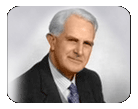

HEAVENLY TEACHING

HEAVENLY TEACHING


 JOSEPH CHARLES PHILPOT (1802-1869)


Preached at Zoar Chapel, Great Alie Street, London, on Lord’s Day Morning, August 6, 1843

"All thy children shall be taught of the Lord." Isa 54:13

THE full extent of the "spiritual blessings" wherewith God has blessed the church in "heavenly places in Christ" can never be thoroughly known in this time-state. It is only when the ransomed of the Lord shall reach the heavenly Canaan, that they will fully know either the awful gulf of misery from which they have been delivered, or the height of bliss and glory to which they are exalted in Christ. But sufficient is revealed in the word of God to shew that they are indeed blessed with peculiar privileges and mercies; and that in being thus blessed their distinction as "a peculiar people" chiefly consists. Moses, therefore, on one occasion thus pleaded with God: "Wherein shall it be known here that I and thy people have found grace in thy sight? Is it not in that thou goest with us? so shall we be separated, I and thy people, from all the people that are upon the face of the earth". Ex 33:16

But of these peculiar blessings that God has blessed his church with in Christ, four seem especially prominent above the rest -their eternal election -their particular and personal redemption -their regeneration- and their heavenly teaching, which last is the promise contained in the text, "All thy children shall be taught of the Lord."

But why should this last occupy a prominent place in the catalogue of covenant blessings? Because without it the others would be in a measure nugatory; for such is the blindness of man’s heart by nature, so thick a vail of ignorance is spread over his understanding, and so completely is he "alienated from the life of God," that he never can have any spiritual knowledge of the "only true God, and of Jesus Christ, whom he hath sent" (in which knowledge eternal life consists) , until he is made a partaker of this divine teaching.

We will endeavour, then, with God’s blessing, to trace out a little of the nature and effects of this divine teaching in the soul. And as it consists for the most part of two leading branches: first, the teaching whereby we know God; and secondly, the teaching whereby we know ourselves, we will look at each of these in their order.


The Sifting of Peter

Simon Peter answered and said, Thou art the Christ, the Son of the living God. Matthew 16:16
He began to curse, and to swear, I know not this Man of Whom ye speak.Mark 14:71
The contrast is a startling one. It is at first sight almost inconceivable that these are the words of the same man, and yet we know that they are. Then surely we have placed them in the wrong order, and ought first to have read “I know not the man,” as language used in the days before he met the Christ; and his declaration, “Thou art the Christ, the Son of the living God,” must have been made subsequently. We know, however, that this is not the case. If, indeed, they have been read in their right order a long period must have intervened between affirmation and denial. As a matter of fact, not many months had passed between the hour in which Peter rose to the height of that most wonderful confession and the hour in which he denied any knowledge of Jesus. So startling an association of texts compels us to inquire the meaning of the change which has come over Peter since that glorious and radiant hour when, amid the rocky fastnesses of Caesarea Philippi, in answer to the challenge of his Lord, he had said the one thing the heart of Christ had been waiting to hear, “Thou art the Christ, the Son of the living God.”
I do not propose to consider particularly that confession of Peter, nor do I intend to dwell at any length upon the final words. I am desirous rather of asking you to consider with me the awful possibility of passing in brief time from the most blessed confession to the most dreadful denial. I think perhaps I might take another text from which to preach tonight, and if I did so it would be by way of application at the beginning as also at the close. The text would be, “Let him that thinketh he standeth take heed lest he fall.” The story of Peter’s denial is the story of backsliding, and it is a story which reveals the truth which we perpetually need to remember, that no man openly backslides at once. The open blasphemy is always preceded by heart backsliding. If we would understand how it came to pass that from that height of affirmation to that depth of denial a man could pass in those few brief months, we must go back to the occasion of the affirmation. We must see what happened immediately afterwards, and then attempt to trace the downward progress of this man, until from mountain height we find him in the depth of the valley.
You will remember that immediately after Peter’s confession our Lord told him of His purpose concerning His Church and His Kingdom.
For the first time He introduced the band of disciples, in so many words, definitely and plainly to the fact of which He had been conscious all the while, that He could win His crown only by way of the cross. Immediately, while the light of the glory of the confession and the annunciation concerning the Church was still about them, I find the first movement in Peter’s backsliding. He said to Jesus, “Be it far from Thee, Lord: this shall never be unto Thee.” As we hear him we are inclined to sympathize with him. We feel that we would have said exactly the same thing under the circumstances, and in all probability we would have. That, however, does not prove Peter to have been right. We may make every excuse that we will–and it is better that we should–for his limited light, for his fickleness and feebleness of character, but the fact remains that in that moment he passed out of immediate and close fellowship with his Lord.
When this man could not see Christ’s method he withdrew from absolute and unquestioning loyalty to his Lord. So long as Jesus had spoken to him of building a Church, Peter remained loyal; but the moment Jesus ceased to speak about keys and began to talk about a cross he was puzzled, astonished, disappointed, confused. He could not see how suffering could be the way to the throne. He could not see how his Master’s going to Jerusalem and being ill-treated, and finally–for he would use no other word–murdered, could issue in the building of that glorious Church to which his Lord had just made reference. He could not see how keys of any kind could be of use to him if the Master were to pass into the shadow and lose His life. Neither could I have seen it, nor could have you. So far, let us confess our perfect sympathy and fellowship with this man. It was a strange thing Jesus said to him. He had so hoped for the coming of a Deliverer. The Deliverer had come, and at last, Peter, in a moment of supreme, divine illumination, had looked into the face of the long-hoped-for Messiah and confessed Him. In his confession there was the outpouring of his soul’s hope of triumph, and victory, of the breaking of chains and loosing of the captives, of the restoration of order and the setting up of the Kingdom of God. I am growingly reluctant to criticize Peter, but for our own soul’s profit let us see wherein lay his mistake. It lay in the fact that he was not prepared to accept his Master’s estimate of necessity, was not prepared to follow his Lord simply, even when he could not understand his Lord’s method. That is the common mistake of the saints. We have all made it, and therefore, sooner or later, we have found ourselves at a distance from Jesus.
The great lesson of Peter’s denial is that wherever there is arrested development of Christian life there must follow deterioration of Christian character. Life must make progress to higher levels or sink lower until it pass away. I must follow Jesus Christ wholly and absolutely without question, or there will be an ever widening breach between Him and myself, until I, even I, presently shall deny Him with blasphemy over some flickering imitation fire. “Let him that thinketh he standeth take heed lest he fall.”
Your affirmation of loyalty is God-inspired. Your confession of Christ is true to the deepest within you. You are perfectly honest and sincere. God help you to follow Him all the way, whether you understand Him or not. God help you at least to keep by His side when clouds almost obscure the vision of His face, for if once you let yourself question His wisdom and His word there will be distance which must increase. Let us trace this in the history of Peter. The whole subsequent story is written for us in chapter 14 of Mark’s Gospel. I am not going to read the whole chapter, but I desire to take you from stage to stage, that you may see how this man passed away from Jesus ever a little further, until we come to the open denial in our second text. Remember that the first step was taken when Peter shunned the cross because he did not understand it, and questioned his Lord’s wisdom when He declared the method necessary to His crowning. You will find the next step in verse 29 of this chapter. “Peter said unto Him, Although all shall be offended, yet will not I.” Then going on to verse 37, I read, “He,” that is Jesus, “cometh, and findeth them sleeping, and saith unto Peter, Simon, sleepest thou? Couldest thou not watch one hour? Watch and pray, that ye enter not into temptation: the spirit indeed is willing, but the flesh is weak.” Notice, the Lord did not call him Peter then. He went back to the old name. The next step is to be found in verse 47. “A certain one of them that stood by drew his sword, and smote the servant of the high priest, and struck off his ear.” Mark is Peter’s friend, and does not mention his name, but we know that the “certain one” was Peter. There we have the next step, and increased distance. I pass on to verse 54 and read, “Peter had followed afar off,” and I think he seems yet a little further away from his Lord. At last he was sitting with the officers and warming himself in the light of the fire. Then, in verses 68-71, a serving maid charges him with being a Galilean, and tells him that his speech betrays him, and thrice, and finally with curses, he denies his Lord. Let us now notice the stages.